Archive for May 2009

Upcoming Wildflower Walks at the Mohonk Preserve, Ulster Co.

May 28, 2009

-Saturday, June 13th, 10am-12noon. Mountain Laurel Walk.
Join Reba Wynn Laks, Director, Stony Kill Farm Environmental Education Center, and take a walk to the Van Leuven Cabin and through the surrounding area to enjoy the peak of the Mountain Laurel blooms. We’ll check out some of the other wonderful blossoms and flowers along the way. Bring water and snacks. Ages 10 and up are welcome. Children must always be accompanied by an adult. This program includes an easy, 2-mile hike. Reservations are required; sign up begins 6/1/09. Call 845-255-0919 for reservations and meeting location.

–Thursday, June 25th, 10am-12noon. Mohonk Preserve Toddlers on the Trail – What’s Blooming?
Join Dana Rudikoff, a parent and enthusiastic hiker, and hike through the forest searching for Mountain Laurel and wildflowers. Ages 2-6 are welcome, accompanied by an adult. Children need to be able to walk or be in a carrier; jogging strollers cannot be used. Reservations are required and there is a 15 parent limit for this program. To register contact hike leader, Dana, by email at dana_rudikoff@yahoo.com. This program will begin at the West Trapps Trailhead and it is suggested that participants come early to secure a parking spot. Walks average 1.5 miles and move at a toddler’s pace. Please leave your pets at home.

Saturday, June 27th, 9;30am-12noon. Wild Plants of the Mohonk Preserve.
Aleese Cody, Herbalist and Mohonk Preserve Volunteer, will lead this program. The green plants of the Earth provide food, shelter, and the very air we breathe. Herbalist Aleese will introduce you to a variety of common plants found in the fields and forests of the Preserve and, quite possibly, in your own backyard. Learn the do’s and don’ts of plant cultivation, uses, and collection. Reminder: there is no collecting of any kind on Preserve lands. Bring a notepad, field guide, and camera. Ages 16 and up are welcome. Children must always be accompanied by an adult. This program includes an easy, 2-mile hike. Reservations are required; sign up begins 6/15/09. Call 845-255-0919 for reservations and meeting location.

Learn about more hikes at the Mohonk Preserve Website.

Why the Pitch Pines Are Turning Brown at Sam’s Point

May 27, 2009

By Gabriel Chapin, Land Steward with the Shawangunk Ridge Program of the Nature Conservancy

It’s springtime again high atop the Shawangunk Ridge at Sam’s Point Preserve and everywhere you look, signs of summer are beginning to appear. Birds are singing, hardwoods are leafing out and azaleas are in bloom. But somewhere between the fading shadbush blossoms and the peak of mountain laurel season, another annual event has been taking place at Sam’s Point…the pines are turning brown. For the past several years at Sam’s Point Preserve, the browning up of over a thousand acres of dwarf pines has become a regular sign of the changing seasons. But what is causing it? The answer, as it turns out, lies within.

Deep inside each and every brown needle, a tiny caterpillar is eating away in preparation for its metamorphosis into a small, nondescript moth know as Exoteleia pinifoliella, the pine needleminer. Despite its deceptively small appearance, the pine needleminer can cause extensive damage, particularly evident at Sam’s Point Preserve in May and even into early June. After hatching from an egg in mid summer, the needleminer, as its name would imply, enters a healthy needle as a small caterpillar and gradually “mines” its way through the center. After overwintering in its cozy “mine”, the hungry larva awakens to feed through the following spring, eventually emerging as an adult in June.

Unlike nearly all of our most famous and devastating forest pests, including the gypsy moth, chestnut blight, Dutch elm disease, and the hemlock wooly adelgid, the pine needleminer is a native forest pest of the northeastern US and parts of Canada. This somewhat finicky caterpillar dines exclusively on “hard” pines, or those having clusters of fewer than five needles, and is particularly fond of both pitch pine and jack pine. Despite the harsh appearance of acres upon acres of browned trees, the pines have adapted to tolerate needleminer damage and few trees actually die. Although more severe infestations may be cyclical—possibly lasting for several years—climate and natural predators generally keep needleminer populations in check. Even after a few years of infestation, the most significant impacts are generally limited to reduced tree growth and greater susceptibility to other more serious pests like bark beetles.

Chemical pesticides can be used to control the pine needleminer in some instances, however, natural predators and other controls usually do the job. Non-native insects and tree diseases, including those mentioned above, have few natural enemies when they arrive on a new continent and native tree species have no defenses to ward off the new invaders. Because of this, non-native pests often cause profound and long lasting ecological damage. Although an extreme case, the chestnut blight nearly wiped out the most dominant and widespread tree in the eastern US in 40 years.

In contrast, periodic infestations by native pests such as the needleminer are part of a natural cycle of disturbance in our native forests that includes, among other things, wildfires, ice storms and hurricanes. Forests in the northeast have adapted to survive or recover from these “native” disturbances and, in some cases, forests may even depend on periodic disturbances like wildfire to maintain their health and vigor.

However, as we move into the 21st Century, global climate change may jeopardize this delicate ecological balance that has evolved over time. Some of the more obvious impacts of climate change—melting glaciers and the like—often mask more subtle changes, including increased wildfire activity and possibly even stronger hurricanes. Subtler still, warmer temperatures are contributing to widespread infestations of forest insects, including spruce bark beetles that have wiped out 4 million acres of spruce trees on Alaska’s Kenai Peninsula. Although naturally more lethal, the native spruce beetle was once limited by the very same factors hold the pine needleminer at bay.

The lesson that we repeatedly learn is that nature is a delicate balance of forces where subtle changes can combine to have profound cumulative impacts. Although the needleminer may not be a significant threat today, continued disruption of other natural process such as climate and wildfire may exacerbate the impacts of this seemingly benign moth. Maintaining the natural processes that keep forests healthy and resilient is the key to preserving our globally rare and treasured pitch pine forests in the Shawangunks.
Trip to Sam’s Point, Ulster County

May 26, 2009

My family and I took a trip to Sam’s Point and the ice caves on Sunday morning. It was a beautiful drive from Ellenville up Route 52 to Cragsmoor Road and then a short drive to the visitor center run by The Nature Conservancy. We hiked the trails northeast to the ice caves but were dismayed by seeing acres of brown pitch pines. The Conservancy is in the process of finding out exactly what is going on. The following were seen in bloom along the trail:

Aralia nudicaulis – wild sarsaparilla
Gaylussacia baccata – black huckleberry
Maianthemum canadense – mayflower
Oxalis stricta – yellow wood sorrel
Photinia melanocarpa – black chokeberry
Potentilla simplex – common cinquefoil
Rhododendron canadense – rhodora
Rhododendron prinophyllum – hoary or mountain azalea
Sisyrinchium sp. – blue-eyed grass
Trientalis borealis – starflower
Trillium undulatum – painted trillium
Vaccinium angustifolium – early lowbush blueberry
Vaccinium corymbosum – highbush blueberry

– Steve Young

New Columbia County Natural History Survey Effort

May 20, 2009

We invite your participation in a new research initiative of the Farmscape Ecology Program: a natural history survey of Columbia County. This project is envisioned as a many-year, many people on-going effort to document the plants and animals that share the county with us.

We’ll start small, with a workshop on Saturday, May 30, 1-5 at the Roeliff Jansen Park in Hillsdale. This workshop will give you a chance to meet the coordinators, Claudia Knab-Vispo (Plants), Conrad Vispo (Butterflies, Dragonflies, Ground Beetles), and Mike Pewtherer (Mammals), and to get a sneek preview of the methods we will be using to learn about and document some of the biodiversity in our landscape. At the end of the workshop, we hope to form three groups of volunteers who are interested in exploring the Roeliff Jansen Park (once a month for half a day, during 2009) and special places throughout the county (once a month for half a day) with us.

You need not have any prior knowledge, just a genuine love for nature and the curiosity and eagerness to learn!

Teenagers through seniors are welcome. We hope to form multi-age, multi-skill teams so that there will be a lot of learning from each other, as well.

Attached you find a more detailed description of the initiative as we envision it. Please contact us if you are interested or if you have any questions. Please contact us also if you would love to participate but can’t make the date for the initial workshop. Feel free to spread the word!

We are looking forward to seeing you soon,

Claudia Knab-Vispo
Farmscape Ecology Program
Hawthorne Valley Farm
327 Route 21C
Ghent, NY 12075
(518) 672-7500 Ext. 254 (office)
(518) 781-0243 (home)
fep@hawthornevalleyfarm.org
http://www.hawthornevalleyfarm.org

Hannacroix Ravine Plants in Flower on May 15, 2009

May 19, 2009

The Capital District Friday Field Group visited the TNC Hannacroix Ravine Preserve in Clarksville last Friday May 15, 2009. Bob Ingalls sent along this list of plants they saw in bloom.

Aquilegia canadensis – Columbine
Barbarea vulgaris – Yellow Rocket
Cardamine diphylla – Toothwort
Cardamine pensylvanica – PA bittercress
Carex communis – communal sedge
Carex deweyana – Dewey’s sedge
Carex gracillima -graceful sedge
Carex laxiflora – broad loose-flowered sedge
Carex pensylvanica – PA sedge
Carex playtphylla – broad-leaf sedge
Carex tonsa var tonsa – shaved sedge
Fragaria virginiana – strawberry
Geranium robertianum – herb Robert
Luzula campestris – common wood-rush
Maianthemum canadensis – mayflower
Maianthemum racemosum – false Solomon’s seal
Polygonatum pubescens – Solomon’s-seal
Prunus virginiana – chokecherry
Ranunculus abortivus – small-flowered crowfoot
Ranunculus recurvatus – hooked buttercup
Ribes cynosbati – wild gooseberry
Ribes rubrum – northern red currant
Sambucus racemosa ssp. pubens – red elderberry
Thalictrum dioicum – early meadow-rue
Tiarella cordifolia – foam flower
Viola conspersa – American dog violet
Viola pubescens – downy yellow violet
Viola rostrata – long-spurred violet
Viola saggitata – arrow-leaf violet
Viola sororia – common blue violet
Waldsteinia fragarioides – barren strawberry

Saratoga Woods and Waterways Blog

May 18, 2009

Visit this beautiful blog about nature in Saratoga County by Jacqueline Donnelly of Saratoga Springs.
http://www.saratogawoodswaters.blogspot.com/

Visit the Cornell Mushroom Blog

May 14, 2009

If you haven’t seen it, Cornell has a fascinating blog about the world of fungi. It is now on the list of links on this blog. Check out the most recent article about fungi and dinosaurs.

Smithsonian’s New Instant Plant Identification Project

May 12, 2009

Will botanists be obsolete in the future? Take a look at the new device that helps identify trees and shrubs by their leaves.

Click Here.

2009 Sedge Workshop with Dr. Tony Reznicek

May 12, 2009

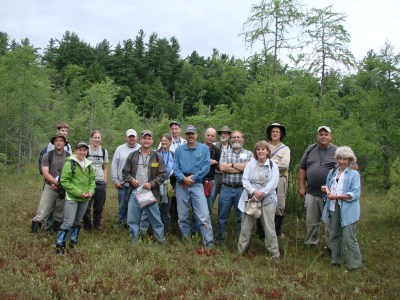
Happy participants of the 2008 workshop

Happy participants of the 2008 workshop

The New York Flora Association is sponsoring a 2 day workshop starting Wednesday June 24th through Thursday June 25th with an optional Tuesday evening session on June 23 for work with your specimens. Dr. Tony Reznicek (University of Michigan), the renowned Carex expert and author to various FNA Cyperaceae treatments, will again lead the workshop. The workshop will be held at SUNY Oneonta. The workshop will include both lab and field exercises. All participants are encouraged to bring plant material from their areas of interest for evening id and discussions with Tony. The workshop will focus on sedges, but rushes and grasses will be discussed also. Participation is limited to the first twenty registrations received. Cost of the workshop is $125 for NYFA members and students; $165 for non-members. Questions and to reserve a spot contact Ed Frantz, 315 793-2421, efrantz@dot.state.ny.us, or Donna Vogler voglerd@oneonta.edu.

October 2008 NY Rare Moss List Now Available

May 7, 2009

Aissa Feldmann of the New York Natural Heritage Program has just posted the new rare moss list for New York State. This is the first revision of the moss list since the late 1980s and reflects the recent work of Nat Cleavitt, Sue Williams and Nancy Slack. Click Here.