Archive for the ‘Happenings’ category

2010 Catskill Watershed Conference Announcement

September 17, 2010

Cornell Cooperative Extension of Ulster County’s Ashokan Watershed Stream Management Program, NYS Department of Environmental Conservation, US Geological Survey, Cary Institute of Ecosystem Studies, New York City Department of Environmental Protection, and the Catskill Institute for the Environment are sponsoring an informal research forum to be held on November 17th and 18th, at Belleayre Mountain Ski Center in Highmount, NY.
This meeting is intended mainly for researchers and resource managers working in the region, but we do not intend this meeting to be exclusive. Therefore, please forward this to others you think may be interested in attending or presenting.

The purpose of this forum is to:

  1. exchange information about current research, monitoring, and data collection efforts within the Catskill Mountains related to
    • climate change
    • stream water quality
    • biodiversity
    • forest health, and
    • stream stability
  2. identify monitoring and research gaps; and
  3. stimulate discussion; and promote collaborative efforts that address present and future environmental issues within the region.

We request that you forward topics for discussion, titles, and abstracts (300 word maximum) for a poster or verbal presentation (15-20 min talks) to Elizabeth Higgins, of Cornell Cooperative Extension of Ulster County, at emh56@cornell.edu on or before October 15, 2010.

Some additional activities will be planned for Wednesday evening and part of Thursday afternoon will be kept open for general discussions and/or breakout meetings.

The submission form is available on the conference website
(www.ashokanstreams.org\research%20 conference.html).  You can also find registration and lodging information there.  A final agenda and program will be forwarded to interested parties in late October and will be available on the conference website.

For more information, contact Elizabeth Higgins at (845) 688-3047 or emh56@cornell.edu.

Caroyln Summers Book Signing at Fiddlehead Creek Nursery

September 4, 2010

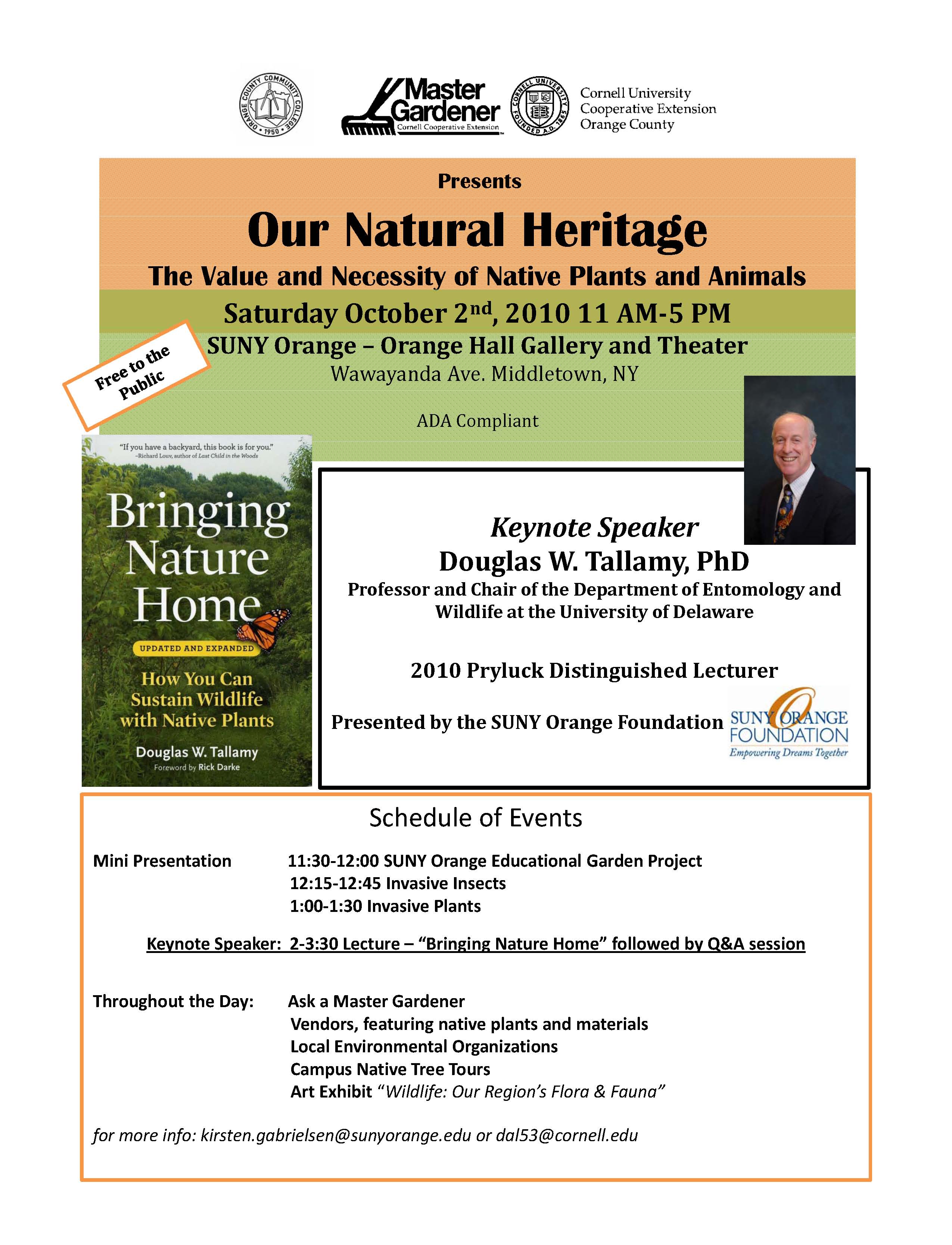
Workshop On The Value and Necessity of Native Plants and Animals

August 23, 2010

Flora Protected Around Hemlock and Canadice Lakes

July 7, 2010

From a DEC press release:

City of Rochester, State Preserve Last Two Undeveloped Finger Lakes in New York

(Thursday, July 1, 2010) – Rochester Mayor Robert J. Duffy and State Environmental Commissioner Pete Grannis announced today that New York State has completed the purchase of Hemlock and Canadice lakes from the City of Rochester for $13.7 million. The transaction, which has been in the works for over two years, will preserve and protect the last two undeveloped Finger Lakes – which have supplied water to Rochester for more than 130 years.

Of New York’s 11 Finger Lakes, Hemlock Lake and Canadice Lake are the only two with undeveloped shorelines. In 1895, the City recognized the value of protecting the source of its public water supply, and thus began acquiring watershed property adjacent to the lakes. By 1950, the City owned 7,000 acres of critical shoreline property. Cottages and houses were removed. Agricultural land was replanted to forest.

City stewardship of the lakes and adjacent lands over the last century has provided a superior water supply while also protecting valuable regional resources, including open space, wildlife habitat and fisheries. As a direct result of City efforts, these are the only Finger Lakes with no shoreline development.

The lakes have been identified as a “high priority” on the state’s Open Space Conservation Program since its inception in 1992 – state acquisition would remove the pressure on the City to sell off the buffer lands for development. Under the terms of the transaction, the state purchased approximately 7,000 acres of land in the towns of Livonia, Conesus, Springwater, Richmond and Canadice. The City will retain the use of the lakes, which serve as much of its drinking-water supply.

Per agreement with the City, DEC will continue property maintenance and preservation that meets or exceeds the City’s current standards, sealing the City’s legacy of good stewardship. Over the long term, a comprehensive unit management plan will be developed for the property, with extensive public input. That process will likely take two or more years to complete.

Workshop on “Gardening With Native Plants on a Budget”

June 25, 2010

The Farmscape Ecology Program at Hawthorne Valley Farm, Columbia County, is offering a four-session workshop on gardening with native plants on a budget, which will be facilitated by experienced landscaper Ruth Dufault of Bittersweet Gardens. The workshop will take place once a month during the summer and will be held at the Creekhouse on Hawthorne Valley Farm in Harlemville, Ghent.

So, what is a native plant? Why should we worry about whether the plants we cultivate in our gardens are native or not? And are there even any native plants decorative enough to warrant their cultivation in an ornamental garden? How about their susceptibility to deer browsing? Which ones need shade, which ones love sun, which ones go together well? And where would I get these native plants from, short of going out and digging them up in their natural habitat?

If you have you ever wondered about any of these questions, this hands-on gardening workshop with landscaper Ruth Dufault (Bittersweet Gardens) offered by the Farmscape Ecology Program at Hawthorne Valley Farm might be for you. Supported by Judy Sullivan from Project Native, who will showcase examples of native plants available at some local nurseries, Ruth will start the four-session workshop with an in-door introduction to gardening with native plants. During the following practical, hands-on, half-day, out-door sessions, Ruth will facilitate the participant’s involvement in planning and implementing a native plant garden around the newly renovated home of the Farmscape Ecology Program, the “Creekhouse” (former Hawthorn Clinic) in Harlemville. She will help participants envision the different native habitats that might be represented in the future garden, facilitate the selection of appropriate plant species, demonstrate soil preparation, and begin the planting process. The workshop is very much geared towards creating an esthetically pleasing, ecologically sound, low cost, low maintenance ornamental garden through a process that can be adapted to the conditions around your own house.

The sessions are planned for:

Friday, July 16th, 7-9pm (Introduction)

Saturday, July 17th, 9-12am (Planning the Garden)

Saturday, August 21st, 9-12am (Implementation)

Saturday, September 18th, 9-12am (Implementation)

The workshop will be held at the Creekhouse, 1075 Harlemville Road, on Hawthorne Valley Farm in Ghent, Columbia County, New York.

Suggested donation is $15/session, $50 for entire workshop, but nobody will be turned away for lack of resources. If you are interested in participating in some or all sessions, please register with the Farmscape Ecology Program, fep@hawthornevalleyfarm.org or 672-7994. For more information on the Farmscape Ecology Program, see www.hawthornevalleyfarm.org/fep.

Hawthorne Valley Farm

Hudsonia – Woody Plant Identification and Natural History in Winter

June 24, 2010

November 5, 2010 — Woody Plant Identification and Natural History in Winter

  • Learn how to use keys to identify trees, shrubs, and woody vines in winter condition
  • Acquire identification skills that are useful for, e.g., wetland boundary delineation, surveys for rare species, habitat identification, reviews of land use proposals, and landscape design
  • Examine the identification characters of many species in the field
  • Browse a collection of books about the identification and ecology of northeastern woody plants
  • Learn how herbarium specimens can be used as reference for identification of new material
  • Discover facts about the natural history and human use of various species
  • Learn where some of the rare woody species occur, which woody plants are useful indicators of environmental conditions, and how certain invasive nonnative species are troublesome in our region.

This workshop is designed for biologists, environmental professionals, horticulturists, and students who already have some field experience with woody plants and want to develop their abilities to identify woody species in winter using twigs, buds, leaf scars, pith, bark, and other winter identification characters. The workshop emphasizes hands-on observation and practice with plants in the field, specimens, hand lens, keys, and field guides.

Course instructors Erik Kiviat PhD and Gretchen Stevens have 40 and 30 years of experience, respectively, with the northeastern woody flora in winter condition.

Lunch and snacks will be provided. Tentative location: Bard College Field Station, Annandale-on-Hudson, New York. 9:00 AM to 5:00 PM. Course materials (books, 10x hand lens) will be for sale at the site. We expect to use Muenscher’s Keys to Woody Plants revised by Cope (2001), and G. Petrides, A Field Guide to Trees and Shrubs 2nd ed. Several binocular dissecting microscopes will be available.

Course fee $275 payable to Hudsonia Ltd by check or credit card (full fee due 15 October, early registration fee $250 by 1 September). Call Linda Spiciarich 845-758-0600 or email spiciari@bard.edu to register.

New Facebook Page for Friends of the Woodlawn Pine Bush Preserve

April 17, 2010

Join this Facebook Page if you are interesting in the preservation of this beautiful part of the Pine Bush ecosystem in Albany and Schenectady counties. It will feature photos of the preserve’s flora, fauna, and ecosystems,  along with volunteer opportunities, events and walks.

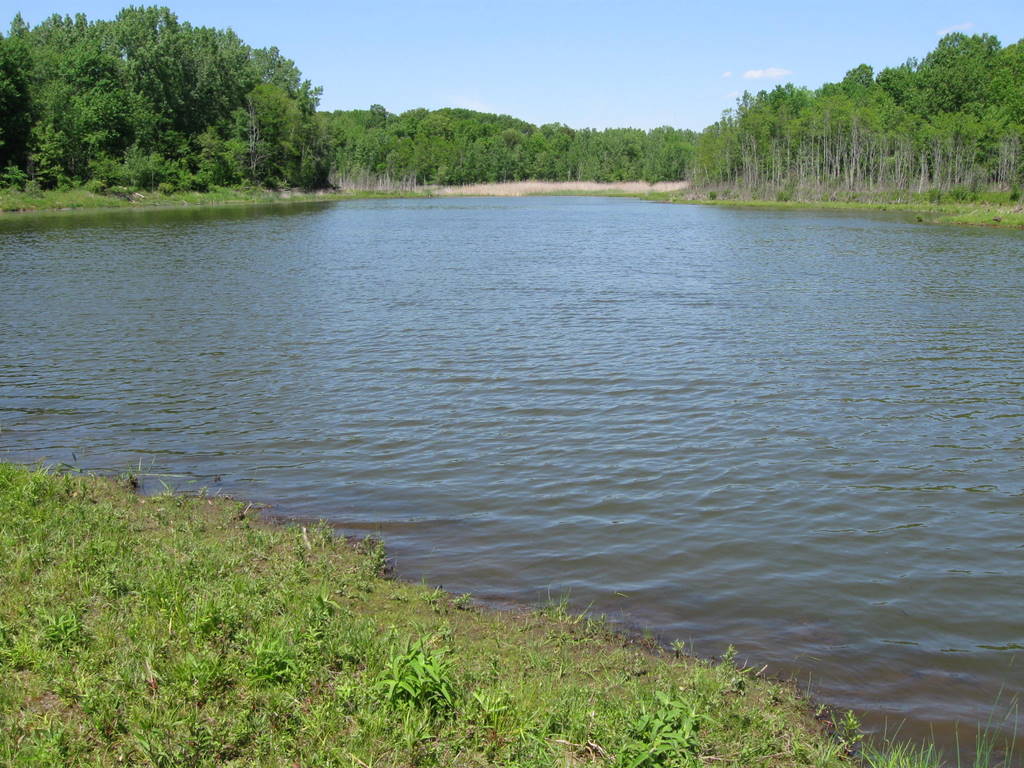
The pond at the Woodlawn Preserve

Watch Rob Naczi’s Lecture on the Future of the The Flora of the Northeastern United States and Adjacent Canada — Advancing the Legacy

April 15, 2010

The video of the lecture is available here: Naczi lecture.

It is 34 minutes long.

ASSISTED MIGRATION OF PLANTS SYMPOSIUM – CHICAGO BOTANIC GARDEN

April 2, 2010

A Janet Meakin Poor Research Symposium
Alsdorf Auditorium
Chicago Botanic Garden
Glencoe, IL
Friday, June 11, 9 a.m. to 5 p.m.

Become enlightened about assisted migration and its role in fighting plant extinction in this year’s Janet Meakin Poor Research Symposium.

When fragmentation limits migration potential of plants or when natural migration and adaptation rates are outstripped by the pace of climate change, some conservation biologists propose purposeful, human-mediated migration, known as “assisted migration” or “managed relocation,” as a way to prevent extinction. In this symposium, we examine this controversial topic from both sides of the issue and suggest ways that the benefits of assisted migration can be maximized while minimizing the costs and risks. Details will be posted as they are confirmed.

For more info go to:
http://www.chicagobotanic.org/school/symposia/JMP.php

Plant Photo Exhibition in Cohoes, NY

March 31, 2010

Naturalist/Photographer Frank Knight’s (NYFA Member)

Seventeen Native Orchids and a Weed

Opening Wine Reception

Friday, June 4th, 4 to 7 pm

Harmony House Marketplace

184-190 Remsen Street, Cohoes, NY 12047    Ph. 238-2232

Across from Smith’s Restaurant and Cohoes Farmer’s Market

Exhibition hours: M, T, 10 – 4 PM, W, Th, F 10 – 7 PM, Sat. 10 – 4 PM