Running time about 11 minutes. This explains the biology of the plant and the consequences of different control techniques.
Archive for the ‘Invasive Species’ category
Information Needed on Callery Pear Cultivars Escaping in New York
May 17, 2011The Bradford Pear, a cultivar of the Callery Pear (Pyrus calleryana), is a popular landscaping tree in the United States. It is a widely used street tree and parking lot tree in most areas of New York State although it is not cold hardy below -28 degrees thus restricting its use in northern New York. The species was originally imported from China to serve as a rootstock for the edible pear when it became susceptible to fire blight in the early 1900s. It was also found to be a good tree for landscaping because of its compact form, profuse white flowers (but with a acrid smell), absence of fruit, and ability to survive in many harsh environmental conditions including along streets and parking lots. Eventually it was found to be susceptible to breakage after about 15-20 years and many other cultivars of the Callery pear were developed to use instead of the Bradford Pear. Even though the Bradford Pear is self-incompatible and does not produce fruit, it is compatible with other cultivars and with the original Callery pear rootstock that often grows into mature trees if left unattended. Fruit from these cultivar crosses are eaten by birds (mostly invasive starlings) and have been germinating in natural areas where they have become invasive. In the Midwest and Southeast they have become a serious problem in natural open habitats.
Is it invasive in New York State? On Long Island there are some reports that show this tree to be spreading into open natural areas.
We need to have more information and evidence that fertile trees are escaping into natural areas in New York so we can evaluate the invasiveness of this species here.
We would like to know the following:
– in what habitats does it occur?
– does it create a new vegetation layer in the habitat?
– does it have an impact on other species?
– are there large dense stands over one quarter acre?
– are the trees primarily in disturbed, weedy areas or in undisturbed areas with few weeds?
– is germination occurring?
If you have a suspicion or know of any places in New York where this tree has escaped into natural areas, please let us know by sending an e-mail to Steve Young smyoung@gw.dec.state.ny.us Thank you.
For more articles on its invasiveness see:
http://weblogs.baltimoresun.com/features/gardening/2010/04/bradford_pear_trees_1.html
http://www.invasive.org/browse/subinfo.cfm?sub=10957
http://grumpygardener.southernliving.com/grumpy_gardener/2011/02/i-just-hate-bradford-pear.html

Use as a street tree. Photo invasive.org
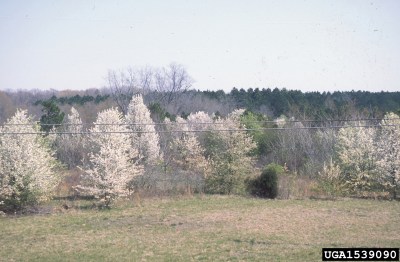
Trees escaping into the wild. Photo invasive.org
Is Wild Chervil Exploding in New York?
May 6, 2011Wild chervil, Anthriscus sylvestris, a non-native plant from Europe seems to be exploding in numbers and range across the state. It can be seen flowering along roadsides, fields and forest edges in late May or early June. I became aware of this plant in the late 1990s when Ed Ketchledge showed me plants that had colonized the road up to Whiteface Mountain. It is getting fairly common in some areas of the Adirondacks now. If you find it outside these areas it would be good to collect a specimen and let the local invasive species coordinator know. Or you can join iMap invasives and map it yourself. They need more data on the species – Steve Young
Here is a video on how to identify it:
Are You An Invasivore?
March 1, 2011You are if you consume invasive species. A new website has been set up to delve into the subject of consuming invasive species.
Here is an excerpt from their introduction:
It’s Invasive Species Awareness Week, and although every week is unofficially Invasive Species Awareness Week here at Invasivore.org, we have decided to treat our readers to a special entrée discussing the invasion process, management of invasions, and the role we envision for invasivore.org within this framework. Ultimately, the true purpose of eating invasive species is increasing awareness; we encourage the lifestyle and political choices needed to prevent species introductions.
VIDEO: Invasive Emerald Ash Borer Upsets Great Lakes Ecosystem, Economy
February 28, 2011Here is a good overview of the effects this insect has had in the Midwest and what we should expect to happen in New York. CLICK HERE.
Below is a video of a June 2010 newscast about the beetle first showing up in Western New York.
Native vs. Invasive Plant ID Workshop in Connecticut
February 25, 2011From Bill Moorhead: CLICK HERE for an announcement of two 1-day plant identification workshops, a Fairfield County edition and a Litchfield county edition, taught by me and co-sponsored by Aton Forest Inc. and Highstead Arboretum, focusing on distinguishing invasive plants from similar native species in the field in late winter/early spring, i.e., in leaf-off condition and/or somewhere between leaf-on and leaf-off. The first takes place on Wednesday, Mar 23, 2011, at & near Highstead Arboretum in Redding, CT, and the second Friday, Mar 25, at & near White Memorial Conservation Center, in Litchfield, CT. At both we will see in the field (weather permitting, in the lab, if not) most of the woody invasive plants that occur in Connecticut, several other non-native woody species that may come to recognized as invasives in the future, and possibly a number of invasive herbaceous species that are detectable at this time of year (if we can see the ground!). Please forward this email to anyone that you know who might be interested in and benefit from it, and please contact me (contact info in the closing) if you have questions about the workshop. I have included on this distribution list many people that I know probably do not need to take this workshop, in hopes that you would forward it to people who would benefit from it, and websites that reach people who would benefit from it.
Thanks and best wishes,
Bill Moorhead
Consulting Field Botanist
486 Torrington Road
Litchfield, CT 06759
Phone & FAX: 860-567-4920
Cell phone: 860-543-1786
Email: whmoorhead@optonline.net
NYS DEC Lands and Forests Job Openings for Giant Hogweed Control
February 15, 2011There are 8 positions open this summer for controlling giant hogweed. Five positions for manual control and three for herbicide control.
Salary
The beginning compensation rate as of April 1, 2010 is $13.27.
To Apply
For more information on how to apply contact Naja Kraus at nekraus@gw.dec.state.ny.us or 845-255-1701 (Fax). First review of applications to begin March 1st.

This is why it is called giant.
Invasive Gnomes Becoming a Problem
January 21, 2011To stay in tune with the coming gnome movie (Gnomeo and Juliet) we found a video to help you control what may be a growing problem. When it comes to invasives we all need some comic relief.- Steve Young
Glimmer of Hope for Northeast Hemlocks
January 12, 2011Northeast forest health managers are cautiously optimistic they might be along the path to protecting threatened Northeast hemlock populations. For the full news release CLICK HERE.
Connecticut to Phase Out 25 Cultivars of Barberry
December 14, 2010Connecticut’s nursery and landscape industry will voluntarily start phasing out the sale and production of 25 Japanese barberry cultivars over the next three years because of their invasive potential (July 1, 2010-June 30, 2013). To see more about this action CLICK HERE. Barberry is also very detrimental to the flora of New York as it invades native understory.


 New York Flora Association Blog