From Rich Ring, Natural Heritage: I went to a New England Botanical Club workshop in Asters this weekend, led by Arieh Tal. It was a good workshop emphasizing the common species, and Tal has developed some unusual, artificial keys that worked pretty well, and has some very good photography on his site. His website with photos and keys of Asters and Goldenrods is http://www.nttlphoto.com/botany/asters-goldenrods/a&g_main.htm.
Archive for the ‘Plant Identification’ category
Identifying Asters and Goldenrods of New England (NY too!)
September 21, 2009NYS Museum Conservation Seminar Series – October Plant Lecture
September 19, 2009The New York State Biodiversity Research Institute and New York State Museum are sponsoring a Biology and Conservation lecture series in October. A variety of speakers will present lectures on recent biodiversity research and conservation initiatives in the state. The lectures are free and will be held at noontime on Wednesdays in the state museum theater.
Wednesday, October 28, Noon
Forgotten Floras: Making the Case for Vouchered Plant Collections
In 2004, a species-area curve analysis revealed that at least 10 counties in the state documented fewer than half the plant species than predicted. Five years later, Otsego, Montgomery and Fulton counties were surveyed, generating more than 1,000 new records, including several rare and some newly invasive plants. Dr. Donna Vogler, of the State University of New York College at Oneonta, discusses the major findings of those efforts and the role of voucher-based natural history collections in the increasingly molecular and digital world of biology.
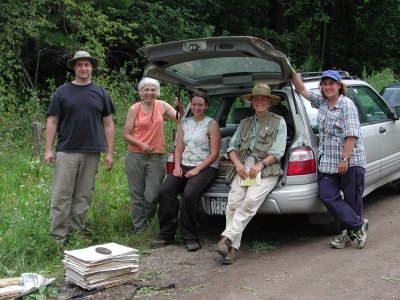
Montgomery County Flora Survey, Doug Idleman, Connie Tedesco, Jamie Barber, Laurie Freeman and Donna Vogler. Photo: Steve Young
Woodbine – The Other Virginia Creeper
September 14, 2009From Steve Young: Until the last few years, whenever I saw Virginia creeper-looking leaves I always called it Parthenocissus quinquefolia. Looking through the grape family keys one day I realized that there are actually two common species of Parthenocissus, P. quinquefolia and P. vitacea, also known as woodbine. Woodbine has an inflorescence branching pattern that repeatedly divides equally and the leaves seem larger and more shiny. They also do not have pads on the ends of the tendrils and usually twine up through shrubs. How common is woodbine compared to Virginia creeper and how consistent are these characters? Karin Verschoor from the Division of Lands and Forests in DEC has been studying the differences between the two plants and will write about them in a future issue of the NYFA newsletter. Below are photos of the inflorescence and leaves of woodbine seen climbing through shrubs along the Mohawk bike trail in Niskayuna, NY. See if you can find both species.
See more info at: http://getyourbotanyon.blogspot.com/2009/09/virginia-creeper-woodbine.html

Woodbine inflorescence with divergent branching
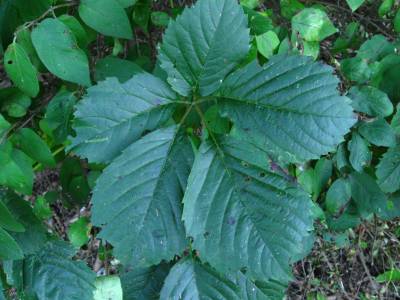
Large and shiny woodbine leaf
Is Newcomb’s Right About Burdock Petioles?
September 10, 2009From Steve Young: Newcomb’s wildflower guide says that Arctium minus, common burdock, has hollow leaf stalks and A. lappa, great burdock has solid leaf stalks. It would be nice if this was consistent so these species could be identified before they flower since the leaves look alike. I have been cutting off leaf stalks near the base and YES, it seems that they can be distinguished that way. You can’t miss those huge leaves along trails and other disturbed areas.
Common burdock has flower heads up to 1 inch wide on short stalks.
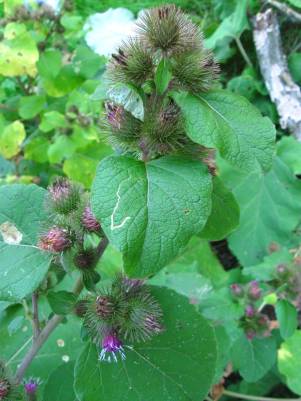
The petioles can have a small hollow center or it can be larger.
Great burdock has heads larger than 1 inch on long stalks.

The petioles are solid.

However, I have not seen any difference in the deepness of the groove on the petiole. Both species have deep grooves. So, check for yourself and see if you find these characters to be consistent. I would be interested to know what you find.
Double-spiked Narrow-leaf Cattail
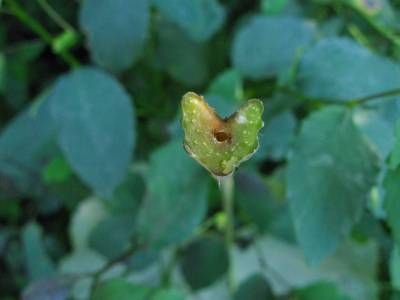
August 21, 2009From Steve Young – When we were in Catskill Marsh last week we came across many examples of narrow-leaf cattail with double spikes that joined together to form the gap you see in the photo below (sorry for the bad focus).
I had never seen this before and would like to know if anyone else has seen it. If you have you may leave a comment below.

Double-spike cattail
“ASTERS of NEW ENGLAND” workshop
August 9, 2009New England Botanical Club SEPTEMBER WORKSHOP
“ASTERS of NEW ENGLAND”
Lead by Arieh Tal
Saturday, 19 September 2009
10 AM for 2-hour indoor session, followed by afternoon field foray
$10 (cash or check made out to NEBC)
101 O’Neil Hall
College of the Holy Cross, 1 College Street, Worcester, MA 01610
BRING: lunch, hand lens, field guides. Cold drinks provided.
See below for registration procedure and directions to Holy Cross.
1) REGISTRATION FOR WORKSHOP: If you wish to register for the aster workshop, please contact Robert Bertin. This workshop has a minimum (8) and a maximum (20). All persons wishing to participate should be in touch with Robert as soon as possible. rbertin@holycross.edu or call 508-793-2352
Try and Collect Some Dodders This Summer
July 18, 2009Dodders of the genus Cuscuta are those strange looking parasitic plants that grow like orange spaghetti over herbaceus vegetation and low shrubs. They are hard to identify because their flowers and fruits are so small that it takes a good hand lens or microscope to discriminate the tiny characters needed for species separation. Soon the new volume of the Flora of North America will be out that treats the genus Cuscuta and we would like to have more recent specimens from around New York to run through the keys. We are especially interested in the difference between Cuscuta obtusiflora var. glandulosa and Cuscuta gronovii var. latiflora in southeastern New York and Long Island. They have similar flowers but their fruits are different. Cuscuta obtusiflora has fruits that are wider than high with a depressed top whereas Cuscuta gronovii has a fruit that is higher than wide with a beak on the top. But just looking at the flowers we think that many specimens of gronovii var. latiflora have been identified as Cuscuta obtusiflora. Also, Cuscuta macrocarpa was once collected along the Mohawk River in the early 1990s near Schenectady and we would like to know if this species is more common than we think. Specimens are best collected with both flowers and fruits on the same plant. Rob Naczi at the New York Botanical Garden is especially interested in receiving specimens as he updates the Cuscuta key for the Northeast in the new Gleason and Cronquist manual. So if you’re out this summer in a meadow or a marsh and you see the distinctive orange spaghetti masses, please grab some and send them on to Rob at:
Dr. Rob Naczi
Herbarium
New York Botanical Garden
2900 Southern Boulevard
Bronx, NY 10458-5126
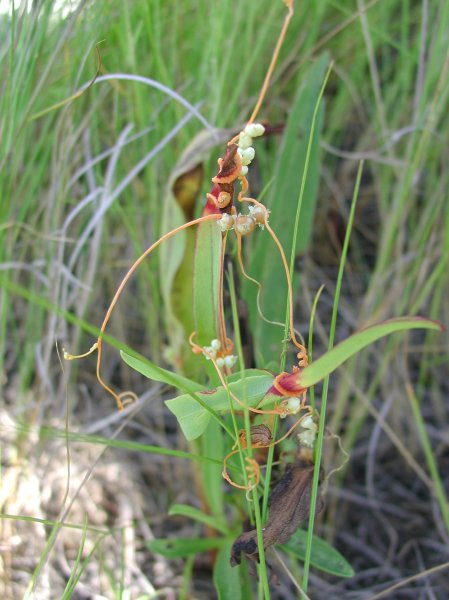
Cuscuta obtusiflora var. glandulosa at Jones Beach LI
New York State DOT Website on Dangerous Plants
July 10, 2009The New York State Department of Transportation now has a website featuring plants that can be dangerous to touch or with dangerous sap. There is information about the plants along with photographs. Access the site at: https://www.nysdot.gov/display/programs/dangerous-plants
Carex Identification Videos Being Posted on YouTube
July 7, 2009In 2008 Steve Young filmed Tony Reznicek identifying Carex species during the NYFA Sedge Workshop in Saint Lawrence County. These videos are now being made available on YouTube. On YouTube click on Channels and search for nyflora1. The Carex videos will be listed. You may also click here.
Large twayblade, Liparis lilifolia, in Canada and New York
June 10, 2009Holly Bickerton, a Canadian biologist, is preparing the Canadian COSEWIC (Committee on the Status of Endangered Wildlife in Canada) status report update for large twayblade, Liparis liliifolia (S2 for ON, S1 for QUE), also a state endangered orchid in New York.
She reports that since the last status report in 1998, eight new occurrences have been discovered in Canada (for a new total of 19 extant occurrences, a substantial increase), with a significant range movement to the north and east. Large new populations have recently been documented near Kingston, ON, and north of Montreal. Previously, the species Canadian range was believed to be near Toronto. Interestingly, the Kingston occurrence is from a red maple swamp growing on sphagnum hummocks, which is a new habitat type for Canadian populations, but is not uncommon in NY. This opens up a lot of potentially suitable habitat in such swamps, across eastern Ontario and western Quebec.
Before the early 1990s the plant was known from the Hudson Valley as far north as Albany County. Then in 1992 and 1994 it was discovered in central New York near Syracuse and along Lake Ontario. Both of these occurrences were on hummocks in red maple hardwood swamps, just a few plants each. Since then we have not found any new occurrences to the north. Our largest occurrence is in a red maple hardwood swamp down in Ulster County. We should be searching more red maple swamps along the Great Lakes and into the Adirondacks to see if populations are expanding north as they are in Canada.


 New York Flora Association Blog