Invasive Species Were a Prevalent Theme at Ecological Meeting

Posted August 11, 2009 by nyflora
Categories: Invasive Species

From Holly Menninger at Cornell: Invasive species were a prevalent theme at the Ecological Society of America’s annual meeting in Albuquerque, New Mexico, August 3-7.

For those of you not able to attend but interested in the research, I’ve created a page with links to abstracts from the meeting sessions and posters that I think will be of greatest interest to NY’s invasive
species crowd. I’ve also highlighted work presented by scientists working here in NYS.
http://nyisri.org/ESAInvasiveTalks.aspx

Be sure to also check out NYISRI’s “Spotlight on Research,” featuring the Fierke Lab’s work on EAB at SUNY-ESF:
http://nyisri.org/Spotlight on Research.aspx

“ASTERS of NEW ENGLAND” workshop

Posted August 9, 2009 by nyflora
Categories: Happenings, Plant Identification

New England Botanical Club SEPTEMBER WORKSHOP

“ASTERS of NEW ENGLAND”

Lead by Arieh Tal

Saturday, 19 September 2009
10 AM for 2-hour indoor session, followed by afternoon field foray
$10 (cash or check made out to NEBC)

101 O’Neil Hall

College of the Holy Cross, 1 College Street, Worcester, MA 01610

BRING: lunch, hand lens, field guides. Cold drinks provided.

See below for registration procedure and directions to Holy Cross.

1) REGISTRATION FOR WORKSHOP: If you wish to register for the aster workshop, please contact Robert Bertin. This workshop has a minimum (8) and a maximum (20). All persons wishing to participate should be in touch with Robert as soon as possible. rbertin@holycross.edu or call 508-793-2352

Why Is The New York Flora Association Website So Old?

Posted August 8, 2009 by nyflora
Categories: NY Flora Association

A few years ago we had to stop updating our website for various reasons but in the last year web desiger Paulina Manzo of Plina Designs and board members Troy Weldy and Adam Ryburn have made a concerted effort to redesign and populate a new website that will be showing up shortly. It will have a new design based on our new logo and will contain all of the features of the old site plus a few new ones. Check back to this blog for an announcement of the date the new site will be ready. It should be soon!

New York Times Featured NYFA Board Member Gerry Moore

Posted August 3, 2009 by nyflora
Categories: Natural History, Plant Sightings, Plant Uses

There is a series of three article where Gerry Moore, botanist at the Brooklyn Botanic Garden and NYFA board member, answered questions about the flora of New York City. See the questions and answers starting here. The series was discontinued after the three installments.

Mid-Atlantic Invasive Plant Conference to be Held August 11, 12

Posted August 1, 2009 by nyflora
Categories: Invasive Species

Please note that the Mid-Atlantic Invasive Plant Conference will be held
on August 11 and 12 at the University of Pittsburgh at Johnstown. To
find out more, visit the Calendar of Upcoming Invasive Species Events
page on NYIS.INFO: http://nyis.info/Tools/Calendar.aspx#Complicating.

Chuck R. O’Neill, Jr.
Sr. Extension Specialist
Cornell University/New York Sea Grant
Director, NY Invasive Species Clearinghouse
Coordinator, Cornell Invasive Species Program
Morgan II, SUNY College
Brockport, NY 14420
Voice: 585/395-2638
Fax: 585/395-2466
E-mail: cro4@cornell.edu
Web site: www.aquaticinvaders.org

Second Annual NYC Wildflower Week a Success

Posted July 31, 2009 by nyflora
Categories: Happenings

The 2nd annual NYC Wildflower Week drew interest from around the world!
Since February 2009, the website has had over 9,500 visitors from every continent and 46 U.S. states.

May 2-9, 2009 celebrated the hundreds of native flowers, trees, shrubs and grasses in the Big Apple, giving New Yorkers numerous ways to connect with and be inspired by their local environment.

A grassroots environmental event, NYCWW featured lectures by keynote speakers, plant walks, educational salons, gardening giveaways, contests, children¹s hands-on activities, and tasting opportunities. Over 40 partner organizations provided programming throughout the five boroughs. Most events were free and open to the public, thanks to the generosity of Con Edison, support of Hudson River Foundation¹s NYC Environmental Fund, and time and talents of our partners and volunteers:
http://nycwildflowerweek.org/sponsors.htm

Hosted by the Torrey Botanical Society, NYC Wildflower Week is dedicated to creating a cultural framework to engage and connect people to their local environments and aims to inspire and empower New Yorkers to create a landscape that is sustainable, beautiful and ecologically sound. It is a celebration of National Wildflower Week, an initiative begun by Lady Bird Johnson.

What You Can Do
Visit wildflowers: http://www.torreybotanical.org/fieldtrips.html
Become our fan on Facebook: http://tinyurl.com/l97g4x
Join our mailing list: http://nycwildflowerweek.org
Learn more about local nature: http://nycwildflowerweek.org/resources.htm
Join Torrey Botanical Society: http://torrey.allenmm.com

Botanically yours,

Marielle Anzelone
Botanist & Native Plant Landscape Designer
Drosera
T 646.244.9397
E marielle@drosera-x.com
W http://www.drosera-x.com

Founder
2nd Annual NYC Wildflower Week
May 2-9, 2009
http://www.nycwildflowerweek.org

NY Emerald Ash Borer Biosurveillance Training

Posted July 30, 2009 by nyflora
Categories: Invasive Species

As you are most likely aware, emerald ash borer (EAB) presents one of the biggest threats to our trees in New York and the northeast. It has already been found in Randolph, NY and may be located elsewhere, undetected. Currently the purple prism traps hung in ash trees, detection trees, and visual inspection are the only tools used to monitor for EAB.

Recent work done by Philip Careless of the University of Guelph has developed to a new monitoring tool. The common digger wasp, Cerceris fumipennis, a natural hunter of Buprestidae is extremely efficient in hunting the members of the local buprestid community. It has been shown to find EAB at low population levels, where purple prism traps are not effective. A large colony of these wasps can bring in over 20 beetles in an hour to quickly assess whether EAB is present or not.

Working with the DEC and USFS, we are trying to locate colonies and monitor for EAB across New York State. Similar work in New England, most notably by Colleen Teerling, an entomologist for Maine Forest Service, has been successful because of the volunteer support she has received. Volunteers assist in locating colonies, ‘adopting’ them, and collecting the beetles brought in by C. fumipennis for an afternoon or two in the summer (think lawnchair, sun umbrella and cold beverages).

We will host a training session on August 6th, 2009 in Syracuse at SUNY-ESF. The training will be comprised of a presentation on C. fumipennis at 10:30am (general biology, past, present and future work, Q and As) and then in the early afternoon we will visit a nearby colony to see them in action and demonstrate how biosurveillance works. We should be done no later than 3 pm. If you can, keep August 7th as a back up day in the case of rain on Wednesday.

Please forward this to anyone who may be interested and do not hesitate to contact me with any questions. Please RSVP at atmospherical5@hotmail.com with the number in your party. More information on the wasp and biosurveillance can be found at http://cerceris.info.

Warren Hellman
EAB Biosurveillance NYS-DEC
SUNY-ESF
Syracuse, NY
Symposium: Evaluating Reintroductions As a Plant Conservation Strategy: Two Decades of Evidence

Posted July 30, 2009 by nyflora
Categories: Happenings

Presented by The Center for Plant Conservation
October 21-22, 2009
Sheraton Clayton Plaza Hotel
7730 Bonhomme Avenue
Saint Louis, Missouri

The Center for Plant Conservation is pleased to announce its fourth symposium entitled, “Evaluating Reintroductions As a Plant Conservation Strategy: Two Decades of Evidence.” In commemoration of 25 years of plant conservation experience, the Center for Plant Conservation is hosting its fourth symposium on plant conservation science at the Missouri Botanical Garden October 21-22, 2009. We will comprehensively review the past and current state of knowledge about plant reintroductions and their role in improving endangered species conservation and these proceedings will be published as an edited
volume. Reintroductions are not only helping the practice of plant conservation, but are also contributing to restoration ecology theory. Understanding the conditions for successful reintroductions is becoming
critical in the face of climate change.

For a detailed meeting agenda and registration form, see the posting at www.centerforplantconservation.org/reintroduction/Symposium/HomePage.htm
or contact Maureen Fischer at Maureen.Fischer@mobot.org

Utica Marsh BioBlitz Results

Posted July 29, 2009 by nyflora
Categories: Happenings, Plant Sightings

The first BioBlitz at Utica Marsh was held on Saturday, June 27, 2009. Congratulations to all participants!

What is a BioBlitz? It’s a one-day intensive survey of all living organisms in a designated area. Why run a BioBlitz? (1) to document which species live in our area to understand local nature better and to provide a baseline for management of Utica Marsh; and (2) to raise awareness in the greater Utica area about the living things that are around us. The BioBlitz was sponsored by the Utica Marsh Council, NYSDEC, and Hamilton College.

See the results at: http://academics.hamilton.edu/biology/ewilliam/bioblitz/

Try and Collect Some Dodders This Summer

Posted July 18, 2009 by nyflora
Categories: Plant Identification, Taxonomy

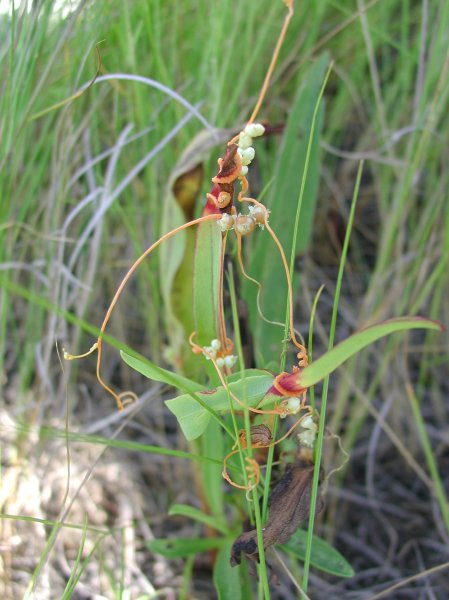
Dodders of the genus Cuscuta are those strange looking parasitic plants that grow like orange spaghetti over herbaceus vegetation and low shrubs. They are hard to identify because their flowers and fruits are so small that it takes a good hand lens or microscope to discriminate the tiny characters needed for species separation. Soon the new volume of the Flora of North America will be out that treats the genus Cuscuta and we would like to have more recent specimens from around New York to run through the keys. We are especially interested in the difference between Cuscuta obtusiflora var. glandulosa and Cuscuta gronovii var. latiflora in southeastern New York and Long Island. They have similar flowers but their fruits are different. Cuscuta obtusiflora has fruits that are wider than high with a depressed top whereas Cuscuta gronovii has a fruit that is higher than wide with a beak on the top. But just looking at the flowers we think that many specimens of gronovii var. latiflora have been identified as Cuscuta obtusiflora. Also, Cuscuta macrocarpa was once collected along the Mohawk River in the early 1990s near Schenectady and we would like to know if this species is more common than we think. Specimens are best collected with both flowers and fruits on the same plant. Rob Naczi at the New York Botanical Garden is especially interested in receiving specimens as he updates the Cuscuta key for the Northeast in the new Gleason and Cronquist manual. So if you’re out this summer in a meadow or a marsh and you see the distinctive orange spaghetti masses, please grab some and send them on to Rob at:

Dr. Rob Naczi
Herbarium
New York Botanical Garden
2900 Southern Boulevard
Bronx, NY 10458-5126

Cuscuta obtusiflora var. glandulosa at Jones Beach LI

Cuscuta obtusiflora var. glandulosa at Jones Beach LI