A future powered by photosynthesis?

Posted February 25, 2012 by nyflora
Categories: Bryophytes, Plant Uses

Check out this research at Cambridge University that uses moss in biological fuel cells to produce electricity! Spoiler alert: it’s actually symbiotic bacteria in the soil that are powering things up using organic compounds released by the photosynthesizing bryophytes.

Read the short article here: http://www.cam.ac.uk/research/features/the-hidden-power-of-moss/

SUNY ESF Alumni Sponsor the Return of the American Chestnut

Posted February 18, 2012 by nyflora
Categories: Happenings, Plant Pathology

On April 18, test trees of American chestnut produced by the Restoration Project at ESF will be planted at an event at the New York Botanical Garden, the place where chestnut blight was first discovered in 1904. The Research Project has more than 100 varieties either in field trials or waiting to be tested.  The event will include a lecture on chestnut trees at 3 p.m. followed by a planting of trees at 4:30 and a reception and dinner at 6:00 in the renovated  stone mill at the garden. Fees are $31 for the lecture and $100 for the dinner. Reservations are required and sponsorships are encouraged.  If you are interested contact the ESF alumni office at 315-470-6632 or alumni@esf.edu. Let’s hope this is the beginning of the return of the American chestnut tree to our eastern forests.

MyNature Apps You Tube Channel Has Many Videos on Identifying Native Plants

Posted February 17, 2012 by nyflora
Categories: Plant Identification, Publications, Apps, and Websites

MyNature Apps has a You Tube Channel  that features many videos on how to identify many of our common wildflowers.

Here is one of his videos identifying Spotted Joe-Pye-Weed.

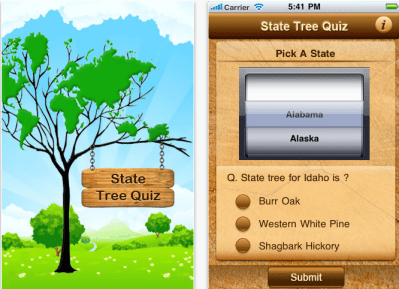
MyNature Apps Has Fun Quiz for Identifying State Trees

Posted February 17, 2012 by nyflora
Categories: Publications, Apps, and Websites

CLICK HERE to see how to get this fun app for identifying state trees.

New Endemic Yellow-eyed Grass, Xyris bracteicaulis, is Described From Long Island

Posted February 15, 2012 by nyflora
Categories: Plant Identification, Publications, Apps, and Websites, Rare Plants

A new yellow-eyed grass, Xyris bracteicaulis (Xyridaceae) has been described by Dr. Lisa Campbell of the New York Botanical Garden. It is known only from a single historical collection from Lake Ronkonkoma on Long Island which also makes it a new endemic plant for the state. The Coastal Plain pondshore habitat in New York supports dynamic plant communities with species rare for the state. In this publication from Harvard Papers in Botany, the new species is described, illustrated, and compared to morphologically similar specimens.  To access the article CLICK HERE.

Carex aggregata Rediscovered in New York

Posted February 12, 2012 by nyflora
Categories: Plant Distribution, Plant Sightings, Rare Plants

By Steve Young, NY Natural Heritage Program

In 2008 Heather Liljengren and Camille Joseph, staff members of the Greenbelt Native Plant Center in Staten Island, were collecting graminoids for seed preservation in Inwood Hill Park on the northern tip of Manhattan Island during the last week of May. They noticed a sedge that looked different and collected it to send off to Dr. Rob Naczi, a sedge expert at the New York Botanical Garden, for identification. Dr. Naczi confirmed it as glomerate sedge. Then in June 2009 Rob Naczi himself discovered it in the southwestern portion of the botanical garden grounds near the Bronx River during a survey of the plants of the Bronx Forest. Both of these discoveries were then reported to the Natural Heritage Program in 2011.

Only three populations of glomerate sedge have ever been reported from New York (there is also a Torrey specimen at NYBG with no location) which is at the northeastern edge of its range. It was first collected from the Perch Lake area of Jefferson County in 1949 then again in 1959 from the Spring Valley area of Rockland County. In 1988 Mike Oldham, a Heritage botanist from Ontario, collected it in Oakwood Cemetery during a trip to the Natural Areas conference in Syracuse. Another trip to the cemetery site in 1990 did not find the plants again. All of these collections occurred during the last week of May or in June. For 20 years there were no more collections or sightings of this sedge in New York until that day in Inwood Park.  This sedge now has the distinction of being the only state endangered or threatened plant that currently exists on Manhattan Island.

From the New York Natural Heritage Program conservation guides we have the following information about identifying this sedge: There are three other members of Carex section Phaestoglochin (C. sparganioides, C. cephaloidea, and C. gravida) that are similar.
Carex sparganioides is perhaps the most different from C. aggregata of these three. It has a more elongated inflorescences (3-15 cm long) with a larger proximal internode. In addition the widest leaf blades are 5-10 mm wide (Ball 2002).

Carex cephaloidea is the most similar to C. aggregata of the species that occur in New York. Carex cephaloidea has the widest leaf blades (4-)5-8 mm wide and the ligules are just longer than wide. In addition, the pistillate scales are 1.5-2 mm long, subobtuse to acute, and the bodies are no more than 0.5 times the length of the perigynia. Mackenzie in his description of C. aggregata (as C. agglomerata) used culm scabrousity to separate C. cephaloidea and C. aggregata. The angles of the culms of Carex cephaloidea being strongly serrulate while those of C. aggregata are only roughened just below the inflorescence. These character states may be incorrect or subtle.

Carex gravida does not occur in NY but was attributed to the state incorrectly in the past. It is not expected in the state. Carex gravida mainly differs in having the summit of the leaf sheath fronts white, hyaline, not thickened, and fragile.

Carex aggregata illustration from Britton and Brown 1913.

Bloom App Brings Spring Closer

Posted February 11, 2012 by nyflora
Categories: Publications, Apps, and Websites

February 11 is the day when the end of winter starts. The dead of winter lasts from January 10-February 10 according to meteorologists and is the stretch of the winter with the coldest temperatures.  If you would like to imagine what spring will bring and you have an iPhone, you can sprinkle a few flowers around your favorite winter landscape with a fun app called Bloom.  You can see how it works in the photo I took below. I feel more cheerful already! – Steve Young


Skunk Cabbage Starting to Appear

Posted February 10, 2012 by nyflora
Categories: Plant Sightings

I checked our local red maple swamp today (no snow and 43 degrees) and the flower spathes of skunk cabbage are starting to poke up through the leaf litter but they haven’t opened yet. – Steve Young

State Champion Asian Bittersweet?

Posted February 10, 2012 by nyflora
Categories: Invasive Species

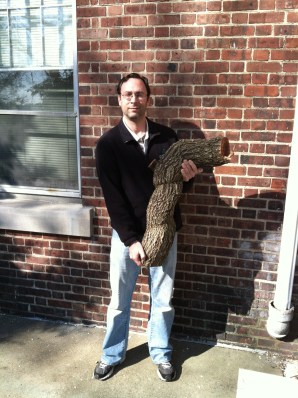
Tim Wenskus from New York City Department of Parks holds the trunk of an Asian bittersweet vine recently cut by Mike Feder in Highland Park on the border of Queens and Brooklyn. This is the largest diameter bittersweet that Tim had ever seen.  Has anyone seen a bigger one?

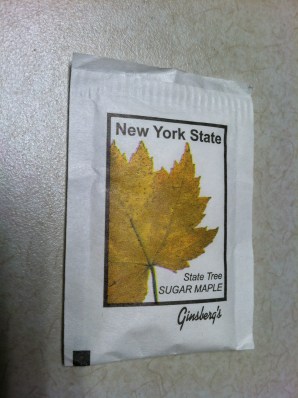
Sugar Maple on Sugar Packet Not Right

Posted February 8, 2012 by nyflora
Categories: Education and Research, Plant Identification

Below is a photo from a Domino sugar packet distributed by Ginsbergs Foods of Hudson, NY from a series that features state symbols. Hmmm, does that look like a sugar maple leaf to you? We hope they get it right the next time, especially since they are a New York company. – Steve Young