The Long Island Botanical Society is raising funds to publish their Atlas of Vascular Plants of Long Island. If you would like to help, the contribution form is below. Click on it for a larger image.

The Long Island Botanical Society is raising funds to publish their Atlas of Vascular Plants of Long Island. If you would like to help, the contribution form is below. Click on it for a larger image.
Connecticut’s nursery and landscape industry will voluntarily start phasing out the sale and production of 25 Japanese barberry cultivars over the next three years because of their invasive potential (July 1, 2010-June 30, 2013). To see more about this action CLICK HERE. Barberry is also very detrimental to the flora of New York as it invades native understory.
David Campbell of Queensbury has established the Adirondack Botanical Garden. Their mission is to promote education in the fields of horticulture, botany, and ecology in the Adirondacks and Capital Region of New York State. For more information go to their website at:
http://www.adirondackbotanicalgarden.org/index.html
We hope to have more information about the garden in a later post.
This is from Tom Rawinski, Botanist, Durham Field Office, N A State & Private Forestry, USDA Forest Service, Durham, NH.
As a society, we are beginning to recognize that a burgeoning deer population is a problem of our own creation – an unintended consequence of eco-environmental gentrification, if you will. The Friends of the Blue Hills (near Boston) is to be commended for furthering the public discussion on this critical issue, found at:
http://friendsofthebluehills.blogspot.com/2010/12/researcher-says-deer-are-killing-forest.html
Additional blog postings – about the Blue hills deer situation – can be viewed at:
http://www.universalhub.com/2010/deer-are-killing-forests-blue-hills-reservation-re
Canadensys announces the release of VASCAN, the Database of Vascular Plants of Canada, a comprehensive list of all vascular plants reported in Canada, Greenland (Denmark) and Saint Pierre and Miquelon (France).
http://data.canadensys.net/vascan/
Canadensys is a Canada-wide effort to unlock the biodiversity information held in biological collections. The network currently includes biological collections from 11 participating universities, five botanical gardens, and two museums, covering insects, fungi and plants. The network is operated from the Biodiversity Centre, Université de Montréal.
The goal of VASCAN is to provide an up-to-date, documented source of the names of vascular plants in Canada, Greenland, and Saint Pierre and Miquelon, both scientific and vernacular. For every species, subspecies and variety, VASCAN provides the accepted scientific name (Latin), the accepted French and English vernacular names, and their synonyms/alternatives in Canada. The distribution status (native, introduced, etc.) of the plant for each province or territory, and the habit (tree, shrub, herb or vine) of the plant in Canada are given. Maps at the provincial/territorial level are provided with an indication of status. For reported hybrids (nothotaxa or hybrid formulas), the parents also are provided. A source is given for each name, classification and distribution information (still being completed).
All taxa are linked to a classification. The following were used: Smith et al. (2006) for ferns, APG III (2009) for flowering plants, and Chase and Reveal (2009) for the higher taxonomy.
It is possible to generate lists in VASCAN using the Checklist builder tool. Data can be downloaded from VASCAN under the Creative Commons (BY-NC) license.
Finger Lakes Native Plant Society Newsletter Articles December 2010
Bailey’s Sedge, Carex baileyi, A New Addition to the Flora of Tompkins County – David Werier
Name That Plant Contest.
Ithaca’s Third Annual Designing with Native Plants Symposium
Native Plant Garden Photos
Beaver Meadow State Forest Takes Unprecedented Steps to Improve Its Forest’s Health via Deer Management – David Werier
Status of Stilt Grass (Microstegium vimineum) on South Hill at Ithaca College – Amber Zadrozny
2010 Stiltgrass (Microstegium vimineum) Eradication Efforts at Six Mile Creek, Ithaca, NY – D. Werier and Krissy Faust
Stiltgrass (Microstegium vimineum) New to Seneca County and Report on Control Efforts – David Werier
Borers and Beetles (Emerald Ash Borer) – Rosemarie Parker
Upcoming Programs
December 16 – Annual Solstice Celebration
January 19 – Bird Friendly Gardening-the Lazy Way – Marie Read
February 16 – Origins of American ethnobotanical medicine – Elroy Rodriguez
March 16 – Native Lawn Establishment – Krissy Boys Faust
May 18 – Night Jewels and Day Marauders: An Insight Into Exotic Life Styles of Moths on Native Plants – Meena Haribal.
To join the Society and obtain more details go to: www.fingerlakesnativeplantsociety
The Long Island Native Grass Initiative presents its first annual native plant symposium Opportunities and Challenges of Working with Native Plants. This full day symposium will focus on the advantages of ecotypic (genetically local) native plant applications in ecological restorations, native plant production and landscaping. Plant propagators, land managers, supervisors, government agencies, non-profit organizations, landscape architects, landscapers, nursery professionals and gardeners are all encouraged to attend.
The Long Island Native Grass Initiative (LINGI) is a cooperative effort of over 30 non-profit organizations, governmental agencies, nursery professionals and citizens. LINGI’s mission is to preserve the genetic integrity of Long Island’s native plants by providing ecotypic seed and plant materials for commercial ecotypic plant propagation, fostering a demand for such plants and increasing the awareness of the importance for the use of ecotypes in the landscape.
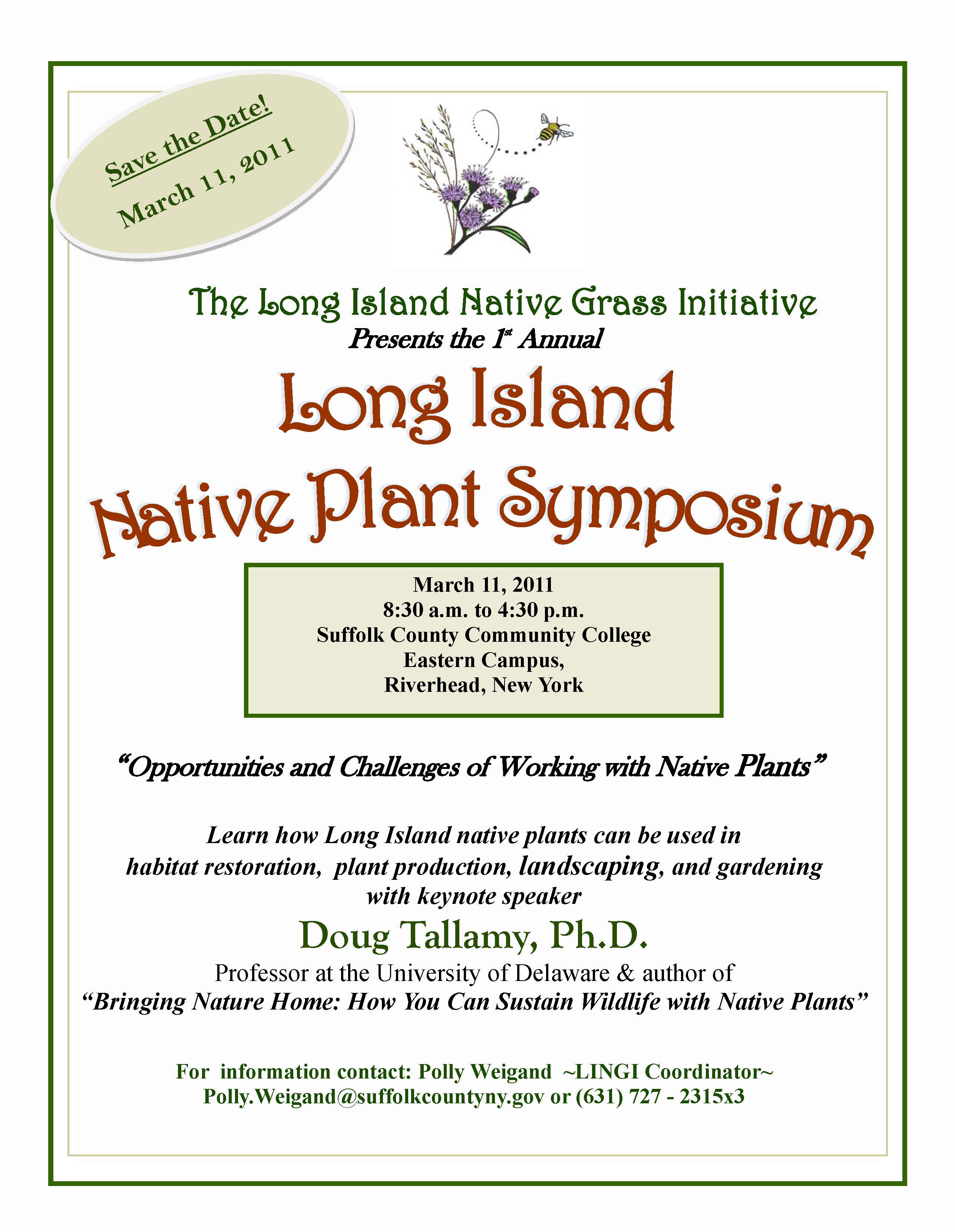
Click for a larger image.
CLICK HERE to see the New York Natural Heritage Program’s rare plant list that you can sort by family, scientific name, common name, Heritage rank or protected status.
From the LCBP Website:
Lake Champlain Clean-Up Plan Signed
The Lake Champlain Basin Program hosted a signature event for Opportunities for Action, the long-term management plan for Lake Champlain on Tuesday, November 30, 2010. Vermont Governor Jim Douglas signed the plan, committing Vermont to many actions to clean-up Lake Champlain. New York Governor Paterson’s signature was presented by Betsy Lowe, NYSDEC Region 5 Director. Stephen Perkins and George Pavlou presented EPA signatures from the Boston and New York EPA offices. Québec’s Premier Jean Charest, represented by Jean Pierre Laflamme from Québec’s Boston office, delivered an endorsement of support for Opportunities for Action.
The new plan identifies eight goal for Lake Champlain; chief among them are reducing phosphorus, preventing toxic contamination, managing aquatic invasive species, and implementing educational programs to increase public involvement in the stewardship of the Lake. For the website and more details CLICK HERE.
This is good news for the native flora that lives in and around the lake – Steve Young.
From NatureServe US: A new report released by the Council of Canadian Academies warns of significant risks to the country’s biodiversity if there is no increased focus and investment in biodiversity science and taxonomic expertise. The report was authored by an expert panel of biodiversity scientists that included Doug Hyde, executive director of NatureServe Canada. CLICK HERE to see the report.
New York State has been without an official State Botanist for years and other taxonomists at the State Musum are set to retire in a few years. We are in a similar situation to Canada.


 New York Flora Association Blog