An unintended consequence of the decline of the newspaper business (our local newspaper is getting really thin now) is the loss of newsprint to press plants. Maybe we should press them between iPads! Any other suggestions? (an iPress?) – Steve Young
The Decline of Newpapers and Pressing Plants
Posted July 24, 2010 by nyfloraCategories: Field Techniques
Botanist Using Apple iPad In The Field
Posted July 23, 2010 by nyfloraCategories: Field Techniques
Below is a photo of botanist David Werier using his iPad in the field to look at plant manuals he has stored on it. David says it saves him a lot of weight and he can carry many references that would have been impossible to bring in the field in the past. It has a protective case and a clear plastic cover over the glass. We were puzzling over a plant in a gorge in the Finger Lakes and it only took a few seconds for David to find the key characters in a manual he has stored on it. He doesn’t use it to enter data and he hasn’t dropped it in the water yet! – Steve Young

EMERALD ASH BORER DETECTED IN STEUBEN AND ULSTER COUNTIES
Posted July 23, 2010 by nyfloraCategories: Invasive Species
From a DEC Press Release:
Additional Investigation Planned After Invasive Beetles Found in Traps
New York State Department of Environmental Conservation Commissioner Pete Grannis and state Agriculture Commissioner Patrick Hooker today announced the discovery of the Emerald Ash Borer (EAB) on private properties in the Town of Bath, Steuben County, and Town of Saugerties, Ulster County. The EAB is a small but destructive beetle that infests and kills North American ash tree species, including green, white, black, and blue ash.
The first detection of EAB in New York was in the town of Randolph, Cattaraugus County, in June 2009 (http://www.dec.ny.gov/animals/56774.html). Since the Randolph find, state and federal officials have implemented an extensive monitoring effort that includes the deployment of approximately 7,500 EAB purple traps in ash trees in high risk locations including major transportation corridors.
The Steuben County discovery occurred on July 12 when a state Department of Environmental Conservation (DEC) staff member inspected one of the state’s EAB purple traps. The traps are sticky and contain a chemical lure that attracts adult EAB. The detection was confirmed this week by Cornell University. The Ulster County discovery occurred on July 15 after USDA’s Animal and Plant Health Inspection Service (APHIS) staff member check of a federally-deployed EAB trap and confirmed by USDA APHIS. Each EAB trap had one confirmed EAB specimen.
Update to Small Whorled Pogonia Orchid Discovery
Posted July 16, 2010 by nyfloraCategories: Plant Sightings, Rare Plant Surveys
After the initial discovery this summer of Isotria medeoloides in Orange County, a follow-up survey was done this week and almost 100 more plants were counted. That is an encouraging sign that the plant is doing well and may be in other areas. The New York Natural Heritage Program is planning to evaluate and search additional habitat in Orange County to see if the orchid occurs anywhere else nearby.
Do You Know What a Novel Ecosystem Is?
Posted July 16, 2010 by nyfloraCategories: Invasive Species, Publications, Apps, and Websites
The concept of Novel Ecosystems is gaining traction in the conservation community and will have implications with how preserves and other natural areas are managed (less management of invasive species for example). In the words of one ecologist, “Novel systems will require significant revision of conservation and restoration norms and practices away from the traditional place-based focus on existing or historical assemblages.” If you are interested in how many conservationists are thinking about the future you should become familiar with this new philosophy. It has many implications about the future of our flora in New York.
For more information go to the Google search page for this topic HERE.
Ed Ketchledge, NY Botanist and Educator, Dies at 85
Posted July 9, 2010 by nyfloraCategories: People
From Steve Young – NY Natural Heritage Program
This link is to an obituary in the Watertown Daily Times:
http://www.watertowndailytimes.com/article/20100702/OBIT01/307029958/-1/obit
I met Dr. Ketchledge in 1971 when I was his undergraduate student in dendrology at SUNY College of Forestry (as it was known back then) at Syracuse in the early 1970s. I remember him as a great teacher (he gave me an A) and I think his love of trees and plants probably rubbed off on me as I found my way to a botany career over the years. Little did I know back then that we would be friends and colleagues as we both worked to preserve the flora of the high peaks of the Adirondacks. When I started working with The Natural Heritage Program in the early 1990s I went on numerous field trips with Ketch to observe the Adirondack flora. We both trained the summit stewards on Whiteface Mountain, a flora he spent many years refining (he was the first one to spot the invasive wild chervil on the Lake Placid turn). He was also especially fond of the plants at Bloomingdale Bog and some of the weird-looking lycopods in the sandy areas of nearby Vermontville. He was an excellent bryologist too and he never failed to point out the interesting mosses he saw along the way. He provided me with a treasure-trove of information about Adirondack alpine plants and I always enjoyed being out in the field and learning from him. In a 1999 letter to me he wrote, “As I reflect back over what I’ve done since surviving combat in WWII, my greatest pleasure and satisfaction is the many lasting friendships that I still enjoy from my years of sharing information with eager young people at ESF, each one a reflection in turn of my own quest for information and knowledge of the natural world from which we spring. I honestly believe I have learned and enjoyed that phase of my career more than any other effort/voyage I have have pursued.”
I will miss him. Below is a photo of Ketch (on the far right) I took in June of 2001 on one of our trips together to Whiteface.

Ketch with the Summit Stewards on Whiteface
In Search of Long Island Rare Plants 2 – White-edge Sedge
Posted July 8, 2010 by nyfloraCategories: Field Trips
From Steve Young – NY Natural Heritage Program
Earlier in June I travelled down to the South Fork of Long Island where, with funding from The Nature Conservancy, I explored various natural areas in search of rare plant populations that have not been seen in 20 years or more. A sedge that had not been surveyed recently was Carex debilis var. debilis or white-edge sedge. The orginal surveys were somewhat vague in their location information so my object was to find them again and update their locations with GPS and obtain quality and quantity information for each population. One of the locations was Big Reed Pond, north of the village of Montauk. After a long walk on the beautiful trails, I found the population that turned out to be in good condition but containing only about 10 plants.
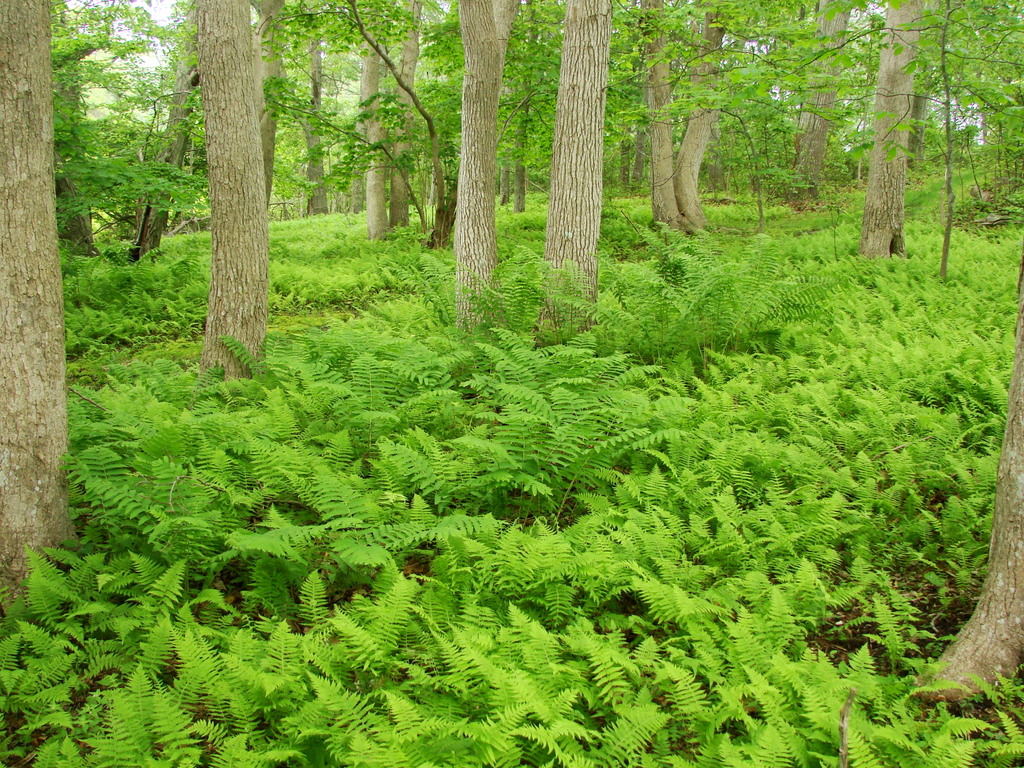
The fern-filled understory of the swamp forest.
Carex debilis var. debilis is a open clump-forming sedge with culms that tend to be lax.
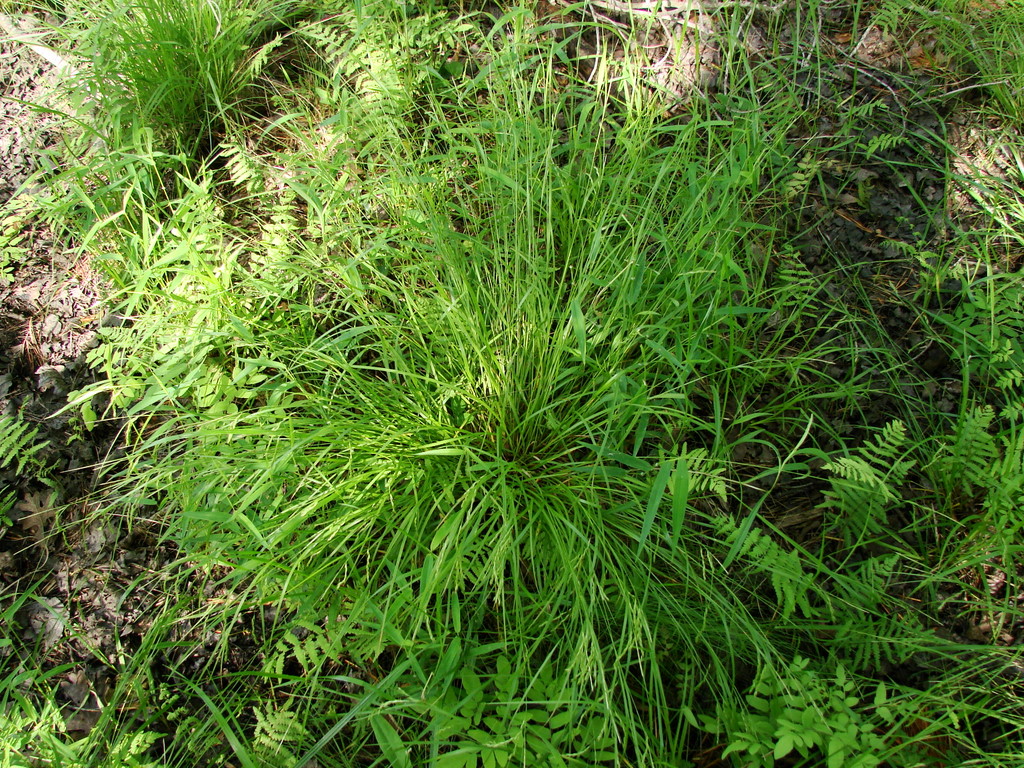
The clumps were along a small trail in the understory of red maple, black gum and oaks.

The perigynia of this variety are drooping, have no hairs and are the longest of the species, averaging about 7 mm long. The beak and the edges of the scales are white-edged and translucent.

On my walk back to the parking lot I passed the memorial plaque to Joe Beitel, a well-known botanist from Long Island that sadly, I never had a chance to meet in person.

Nearing the parking lot the forest turns to shrubland with interesting plants like winged sumac and the two Southern arrowwood varieties (more about these varieties in a future post).

The hairy stems of winged sumac.

And its beautiful leaves.
On the way back to my base of operation I passed a wet sandy swale that was full of the rare threadleaf sundew or dew-thread, Drosera filiformis. The sun shining at a low angle produced small clouds of dew above the surface.

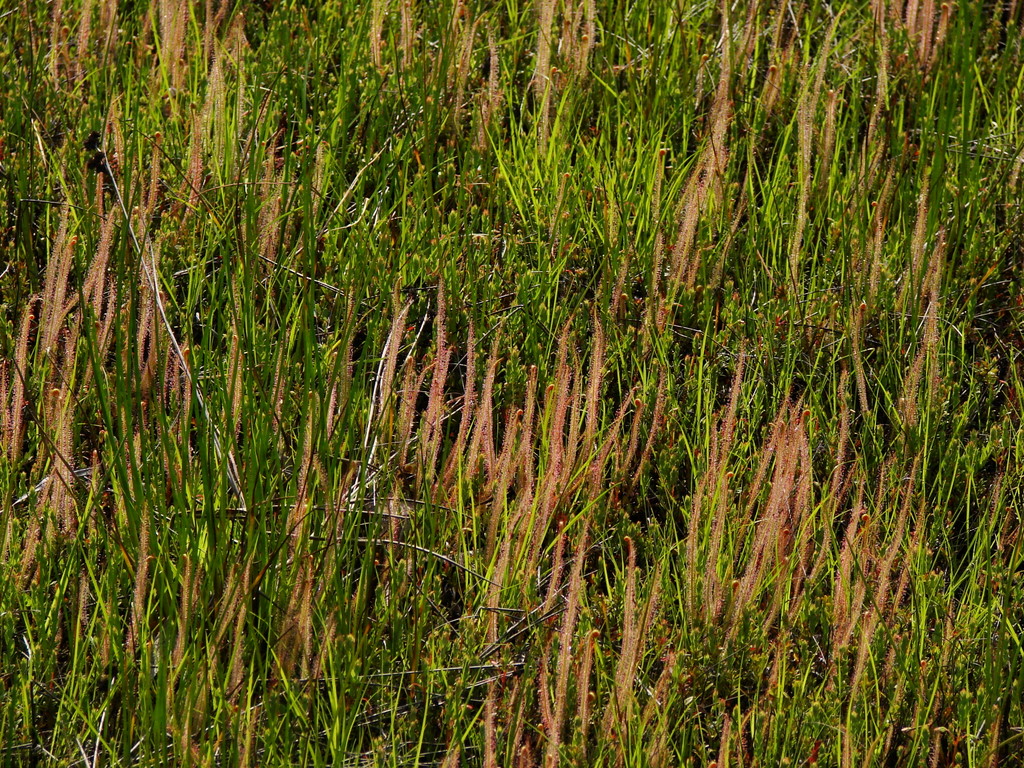
In New York, these sundews are only found in Suffolk County.

The long leaves are covered with sticky glands that capture insects.
Also hidden among the sundews was one of the few populations of Carolina clubmoss, Pseudolycopodiella caroliniana, that exists in New York. Interestingly, this species has one population in Suffolk County, one in Nassau County and one way up in a fen near Lake George, an unexpected distribution.

This species has small, light green prostrate creeping stems. No strobili were evident yet on these plants.
I am going back to the South Fork next week to look for more of its interesting rare plants. I can’t wait.
Scientific Name Changes in the New Rare Plant Status List
Posted July 7, 2010 by nyfloraCategories: Taxonomy
The 2010 Rare Plant Status Lists contain some scientific name changes that are listed here, old name first then new name. To see further explanations of why they were changed you can type the new name into the NY Flora Atlas. www.atlas.nyflora.org. Some of the species are in Newcomb’s Wildflower Guide and should be changed there too.
Aristolochia serpentaria – Endodeca serpentaria (In Newcomb’s)
Boechera shortii – Boechera dentata
Empetrum eamsii ssp. atropurpureum – Empetrum atropurpureum
Empetrum nigrum ssp. hermaphroditum – Empetrum nigrum
Erechtites hieraciifolia – Erechtites hieraciifolius (In Newcomb’s)
Eriophorum angustifolium ssp. scabriusculum – Eriophorum angustifolium ssp. angustifolium
Eupatorium hyssopifolium var. laciniatum – Eupatorium torreyanum
Eupatorium rotundifolium var. ovatum – Eupatorium pubescens
Helianthemum dumosum – Crocanthemum dumosum
Helianthemum propinquum – Crocanthemum propinquum
Lespedeza violacea – Lespedeza frutescens (In Newcomb’s)
Loiseleuria procumbens – Kalmia procumbens (In Newcomb’s)
Neobeckia aquatica – Rorippa aquatica
Zigadenus elegans ssp. glaucus – Anticlea elegans ssp. glaucus
Zigadenus leimanthoides – Stenanthium leimanthoides
Flora Protected Around Hemlock and Canadice Lakes
Posted July 7, 2010 by nyfloraCategories: Happenings
From a DEC press release:
City of Rochester, State Preserve Last Two Undeveloped Finger Lakes in New York
(Thursday, July 1, 2010) – Rochester Mayor Robert J. Duffy and State Environmental Commissioner Pete Grannis announced today that New York State has completed the purchase of Hemlock and Canadice lakes from the City of Rochester for $13.7 million. The transaction, which has been in the works for over two years, will preserve and protect the last two undeveloped Finger Lakes – which have supplied water to Rochester for more than 130 years.
Of New York’s 11 Finger Lakes, Hemlock Lake and Canadice Lake are the only two with undeveloped shorelines. In 1895, the City recognized the value of protecting the source of its public water supply, and thus began acquiring watershed property adjacent to the lakes. By 1950, the City owned 7,000 acres of critical shoreline property. Cottages and houses were removed. Agricultural land was replanted to forest.
City stewardship of the lakes and adjacent lands over the last century has provided a superior water supply while also protecting valuable regional resources, including open space, wildlife habitat and fisheries. As a direct result of City efforts, these are the only Finger Lakes with no shoreline development.
The lakes have been identified as a “high priority” on the state’s Open Space Conservation Program since its inception in 1992 – state acquisition would remove the pressure on the City to sell off the buffer lands for development. Under the terms of the transaction, the state purchased approximately 7,000 acres of land in the towns of Livonia, Conesus, Springwater, Richmond and Canadice. The City will retain the use of the lakes, which serve as much of its drinking-water supply.
Per agreement with the City, DEC will continue property maintenance and preservation that meets or exceeds the City’s current standards, sealing the City’s legacy of good stewardship. Over the long term, a comprehensive unit management plan will be developed for the property, with extensive public input. That process will likely take two or more years to complete.
NYS INVASIVE SPECIES COUNCIL RELEASES PLAN TO COMBAT INVASIVE SPECIES IN NYS
Posted July 7, 2010 by nyfloraCategories: Invasive Species
The following is from a DEC press release:
Report Identifies New Process to Categorize Non-Native Invasive Species
The New York State Invasive Species Council today (July 6) submitted its final report to Governor David A. Paterson and the State Legislature. The report, titled A Regulatory System for Non-Native Species, recommends giving the Council authority to develop regulations for a new process that will prevent the importation and/or release of non-native invasive species in New York’s waterways, forests and farmlands.
The report, prepared by the nine-agency Council and co-led by the Department of Agriculture and Markets and the Department of Environmental Conservation, introduces a new process for assessing each invasive species for its level of threat, its socioeconomic value, and for categorizing them into distinct lists for appropriate action.
State Agriculture Commissioner Patrick Hooker said, “In recent years, we have struggled with the economic and environmental impacts of non-native species such as Plum Pox Virus, Emerald Ash Borer and the Asian Longhorned Beetle, but we have also acknowledged the positive aspects associated with some, such as timothy, Norway maple and
lady bugs. With the adoption of this report, New York will now have a process by which the merits of various invasive species will be evaluated and their level of harm and/or benefit will be reviewed to ensure unacceptable ecological or health risks are not purposefully introduced as pets, nursery stock, food or other uses.”
State Environmental Conservation Commissioner Pete Grannis said, “New York needs to take action now to curb the many pathways that invasive species use to make their way here. With this new regulatory approach, we can do just that. The system the Council is proposing strikes the right balance of minimizing the major threats to our ecology and economy while allowing for the careful use of those plants and animals that pose lower risks.”
The new assessment process would allow the state to categorize invasive species such as zebra mussels, Sirex wood wasps and Eurasian milfoil as “prohibited,” “regulated” or “unregulated.” As a result of this classification system, regulatory control where necessary, would help restrict movement of potentially harmful plants and animals.
Species in the “prohibited” category would be the most restricted as they pose clear risks to New York’s economic, ecological and public health interests, and, therefore, would be banned from commerce entirely. “Regulated” species would be restricted, but not prohibited from commerce, and require practical and meaningful regulatory programs. “Unregulated” species would be identified as those non-native species that do not pose a threat and therefore could be used freely in commerce.
Two “tools” would be used in assessing risks from non-native plants and animals. One evaluates the inherent, biological
“invasiveness” of each species, i.e., some species are better “weeds” than others. The other tool looks at socio-economic values to help the Council decide whether the social benefits of a plant or animal outweigh the potential harm. For example, earthworms have often been shown to have positive effects on soil structure and fertility in agricultural and garden ecosystems; however, glacial ice sheets that covered most of New York some 11,000 to 14,000 years ago
left New York worm free. Thus, today’s worms are actually European invaders and considered a non-native invasive species, but are clearly valuable.
The process of categorizing invasive species and other report recommendations were developed with the assistance of a 17-member steering committee comprised of representatives from state and federal agencies, conservation, academic and industry groups including agriculture, pets, nursery and landscape. In addition to Department of Environmental Conservation and Department of Agriculture and Markets, the Council is made up of the Commissioners of Transportation, Parks, Recreation and Historic Preservation, and Education; the Secretary of State; the Chairperson of the New York State Thruway Authority; the Director of the New York State Canal Corporation; and the Chairperson of
the Adirondack Park Agency.
The New York State Invasive Species Council*s final report is available online at
http://www.dec.ny.gov/animals/63402.html.
New York State is engaged in efforts to reduce the impacts of existing invasive species, such as the Asian Longhorned Beetle and most recently, the Emerald Ash Borer. Department of Agriculture and Markets’ horticultural inspectors have successfully treated 549,856 trees in Brooklyn, Queens and Staten Island as part of efforts to eradicate the Asian Longhorned Beetle and protect our forests and urban trees. The Emerald Ash Borer was found in Randolph, Cattaraugus County, in June 2009. The Departments of Environmental Conservation and Agriculture and Markets responded quickly and removed affected trees. Since that time over 387 compliance agreements have been written to prevent the human spread of the Emerald Ash Borer.


 New York Flora Association Blog