Kudzu in Albany, Here and Gone

Posted September 29, 2009 by nyflora
Categories: Invasive Species

In 2006 a DEC forester was taking his afternoon exercise walk in downtown Albany and noticed this big leafy legume vine smothering a privacy fence.  He took some digital pictures and notified Jerry Carlson, DEC State Plant Pathologist, of the location.  Ken Carnes, State Survey Coordinator from the New York Department of Agriculture and Markets, siezed the opportunity to “test-out” their new Trimble GPS backpacks and documented the location with pin-point accuracy.  Later that winter, Heather Coiner, a graduate student at the University of Toronto who was studying the influence of climate change and the spread of kudzu, called from Canada and requested a kudzu sample to test for winter hardiness.  After Ken and Heather dug up four of the six plants, the property owner expanded his parking lot and destroyed the remaining plants. Its location along a fence line suggested that it had been planted. Fortunately no other kudzu plants have been found in the Capital District area. Heather is in the last stages of completing her PhD at the University of Toronto.

Kudzu Vine in Albany

Kudzu Vine in Albany

Another Invasive Grass to Watch Out For

Posted September 28, 2009 by nyflora
Categories: Invasive Species

We recently posted an alert for false brome grass but Marilyn Jordan from TNC Long Island is also concerned about wavy leaf basketgrass showing up in New York.

Oplismenus hirtellus (L.) P. Beauv. ssp. undulatifolius (Ard.) U. Scholz

Reported though the Mid-Atlantic Exotic Pest Plant Council listserve. According to USDA plants the subspecies is only found in MD, but postings to the ma-eppc listserv indicate it is also in VA and FL. There
may be taxonomic confusion with the species Oplismenus hirtellus (L.) P. Beauv. Wavy leaf basketgrass is more competitive than Japanese stilt grass, and “An ornamental variegated pink, green and white form, sold as O. hirtellus ‘Variegatus’ for hanging baskets (Fig. 11), has spontaneously reverted to an all-green, wavy-leafed, very aggressive form under greenhouse conditions (Pohl 1981; see MD DNR poster).” The
ssp has been sold in CT according to LIISMA SRC member J. Lehrer. Information and photos of the ssp are available at:
http://www.dnr.state.md.us/wildlife/download/wlbg_poster011108.pdf  and
http://www.dnr.state.md.us/wildlife/WLBG/wl_basketgrass_ID.asp

Long Island Plant Sightings May 2009

Posted September 25, 2009 by nyflora
Categories: Plant Sightings

From the Long Island Botanical Society:

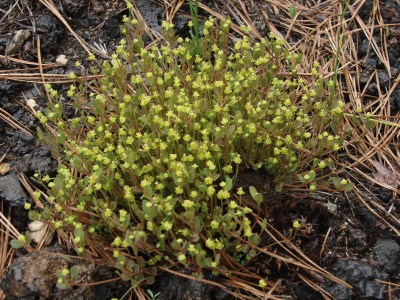
Corydalis sempervirens, pink corydalis (Fumariaceae, the Fumitory Family; formerly included in the Papaveraceae, the Poppy Family). This delicate, showy spring wildflower is very rare on Long Island; the LIBS draft atlas of vascular plants records it from only one unspecified locality in Suffolk County. On 30 May 2009, George Dadone found a naturally occurring population of pink corydalis at the former Pilgrim State Hospital property in Edgewood. Rich Kelly, Donald House, and Paul and Mary Beth Tomko accompanied George.
Silene caroliniana ssp. pensylvanica, wild pink (Caryophyllaceae, the Pink Family). Rich Kelly, Donald House, et al. observed a small population of this state-listed, rare plant at the former Pilgrim State Hospital property in Edgewood on 30 May 2009. Steve Young of NYNHP has been closely monitoring this species in New York and has reported a decline in occurrences possibly due to browsing by herbivores.

Wild Pink, Silene carolininana ssp. pensylvanica

Euphorbia ipecacuanhae, ipecac spurge (Euphorbiaceae, the Spurge Family). This species is at its northern range limit on Long Island; in New York, it is known only from Suffolk County where it usually occurs in extremely nutrient poor, well drained, dry sandy soils. Usually, occurrences on L.I. consist of very few individuals (fewer than a dozen widely scattered individuals). On 30 May 2009, Rich Kelly, Donald House, et al. observed three widely scattered individuals of ipecac spurge at the former Pilgrim State Hospital property in Edgewood.

Ipecac plant at Edgewood

Ipecac plant at Edgewood. Photo: Steve Young

Viola pedata, bird’s foot violet (Violaceae, the Violet Family). On 31 May 2009, John Heidecker observed a large colony of bird’s foot violet in full flower growing in sandy soil along Grumman Blvd. in Calverton, a short distance from the Swan Lake Golf Course. Thirty years ago, this showy violet was relatively common throughout regions of Long Island, but today it is rarely observed. The decline of this species on L.I. is mostly attributed to habitat destruction, road expansion and maintenance projects, and chemical herbicides applied along the borders of railroad tracks.

Viola pedata at Edgewood

Viola pedata at Edgewood. Photo: Steve Young

The New England Chapter of the North American Lake Management wants to remind you that the Annual Symposium is almost here!

Posted September 24, 2009 by nyflora
Categories: Happenings

Oct 27 – 31, 2009 * Hartford, CT

Designed for environmental and watershed professionals, federal, state and municipal agency personnel, monitoring coordinators, lakeside residents, lake or watershed association leaders or members – this diverse conference has something for everyone!

  • Pre- and post conference workshops offer hands on training on topics ranging from watershed modeling, identifying aquatic plant, an introduction to electrofishing, writing effectively to starting a volunteer monitoring program – and much in between. (Descriptions available on line!)
  • Technical sessions bring together national (and international) experts from the fields of remote sensing, invasive species, cyanobacteria, lake policy and management, and many more!
  • Vendors representing lake management, water quality monitoring equipment, education and outreach programs and more will be on hand to share their product and services. Booths are filling fast – so don’t miss out on the chance to get the word out about your business!
  • Special events – taking advantage of our location on the beautiful Connecticut River, our annual 5K walk and run will be in parkland along and over the river. On Friday night we invite everyone to experience a traditional New England Clambake – complete with a boat ride up river to Riverfront Recapture’s (http://www.riverfront.org/) boathouse (additional fee required!
  • Lake and Watershed Stewards special registration package provides lake and watershed association members access to the technical sessions of their choice on Friday and workshops on Saturday for a much reduced price – but these subsidized packages are limited – so act fast!

Please see www.nalms.org for information about exhibiting, sponsorship, registration, including our special Lake and Watershed Stewards package, as well as special events. This year we are expecting a spectacular foliage season with unusually vibrant colors here in New England and the Connecticut Department of Environmental Protection’s foliage report estimates that the peak will occur during the conference. With some much to do so close by, Hartford will be a great place to not only network with lake and watershed folks, but to bring the whole family!

Don’t miss this chance – NALMS won’t be back in New England for years!

Elizabeth Herron
Co-chair
NALMS 2009 Conference Committee
Phone: 401-874-4552
Fax: 401-874-4561
Web:http://www.nalms.org

Dreaded Invasive Kudzu Vine Has Been Found in Ontario

Posted September 23, 2009 by nyflora
Categories: Invasive Species

From the Ontario Federation of Anglers & Hunters: It has been taking over fields, roadside signs, fences, trees, and even houses in the United States for years, but now, the kudzu vine (Pueraria montana) has been discovered in Ontario, on the shores of Lake Erie near the town of Leamington. The kudzu vine is a native of Eastern Asia, and was first brought to North America in 1876 for a centennial exhibition. It was later used for erosion control and promoted as a forage crop. Eventually, it took over much of the southern states and despite attempts to stop it, has continued to spread northward.

“We have been watching the kudzu vine move toward Canada for some time now, with great apprehension. Our colleagues in the south have been fighting a tough battle with this invader, so we need to take immediate action in Ontario to stop kudzu in its tracks,” says Rachel Gagnon, Coordinator of the O.I.P.C. (Ontario Invasive Plant Council), a collective of organizations collaborating to address the spread of alien invasive plants in Ontario. “Fortunately, it’s been found early, so unlike previous invaders, such as dog strangling vine, we have the potential to eradicate kudzu and protect Ontario’s biodiversity. Controlling this menace is critical to maintaining our native plants and wildlife habitat. If we let kudzu become established, it will cause untold ecological and economic damage.”

Like all other invasive species, when the vine takes to its new environment it spreads quickly at the expense of native species, including trees, which are girdled by the vine; broken by its weight; or killed by lack of light. The kudzu grows at an astounding rate of 30 centimeters (one foot) per day, and in a single season can grow up 30 meters (90 feet) in length.

Control measures include hand cutting, mowing, controlled burns and herbicide. Grazing animals, such as goats and pigs have also been effective at containing the spread of the vine over the long term.

The O.I.P.C. is a non-profit, multi-agency organization that facilitates a coordinated response to the threat of invasive plants. The council provides leadership, expertise and a forum to educate, motivate and empower organizations and citizens.

The Ontario Federation of Anglers and Hunters, Ontario’s largest nonprofit, fish and wildlife conservation organization, houses the O.I.P.C. and supports its efforts. Visit www.ofah.org to learn more about the O.F.A.H.

To report a sighting of the kudzu vine or any other invasive species, call the O.F.A.H./M.N.R. Invading Species Hotline at 1-800-563-7711.Visit www.ontarioinvasiveplants.ca to download a fact sheet on the kudzu vine, or to learn more about other invasive plants.

New York Note:  the earliest record for New York State is around 1900 on Staten Island.  It is now well distributed around the NYC and Long Island area.  More info on its distribution around NYC can be found in the 1989 article by Edward Frankel in Bulletin of the Torrey Botanical Club 116(4). 1989. pp. 390-394.

Identifying Asters and Goldenrods of New England (NY too!)

Posted September 21, 2009 by nyflora
Categories: Plant Identification

From Rich Ring, Natural Heritage: I went to a New England Botanical Club workshop in Asters this weekend, led by Arieh Tal.  It was a good workshop emphasizing the common species, and Tal has developed some unusual, artificial keys that worked pretty well, and has some very good photography on his site.  His website with photos and keys of Asters and Goldenrods is http://www.nttlphoto.com/botany/asters-goldenrods/a&g_main.htm.

Slender False Brome Photos Showing Invasion of Bergen Swamp

Posted September 21, 2009 by nyflora
Categories: Invasive Species

Steve Daniel sent a couple of photos of the invasion in Bergen Swamp.

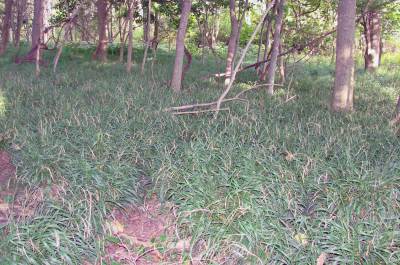
A solid stand at Bergen.

A solid stand at Bergen.

Drooping spikelets

Drooping spikelets and bright green leaves

Breaking News! Slender False Brome, Invasive Grass Found in New York

Posted September 19, 2009 by nyflora
Categories: Invasive Species

From Steve Young: Slender false brome grass (Brachypodium sylvaticum) was recently found in Bergen Swamp in western New York by naturalist Steve Daniel. Until now this invasive grass was only found in Oregon where it has been a serious invader covering tens of thousands of acres, and also recently in Virginia and Northern California. Active attempts at control are underway in these states. This plant can form extremely dense solid stands in a variety of habitats, eliminating native vegetation. It has probably been in New York for some time and been overlooked because it resembles other brome grasses or species of Elymus.

Steve has corresponded and sent several photos and specimens to Tom Kaye, Ph.D., of the Institute for Applied Ecology in Corvallis, Oregon, and Rob Naczi of the New York Botanical Garden and it has been confirmed as Brachypodium sylvaticum. Tom has been a key player in a partnership of The Nature Conservancy, USDA Forest Service, USDI BLM, and other organizations, and they have formed a “False-Brome Working Group” that has been active in outreach and investigating effective means of control. See the websites:

http://www.appliedeco.org/invasive-species-resources/FBWG

http://www.calapooia.org/wp-content/uploads/2009/01/FB_brochure.pdf

Tom has been extremely helpful in sharing his experience with this species in Oregon. The following note, from Tom, may be helpful moving forward:

“You clearly have a well established population that has fully invaded some habitats and is starting on others. The pattern you have observed is typical of the invasion process we see here. Plants start at trail heads, along trails or roads, then spread along forest edges and into the forest stand. Next and more slowly, but still successfully, they spread into areas with more light, such as your marls. The plants appear to do well in dry sites as well as wetlands.
My recommendation would be to focus on containment of the invasion. Remove plants from trail sides and trail heads/parking areas, and any place people would sit or gather. The species is also spread easily and quickly by deer, which is harder to control. You may want to visit other recreation areas nearby to see if it has already invaded there. For a while, it seemed like I would find this species wherever people from my town traveled. It really gets everywhere, and recreationists are major vectors. Finally, conduct outreach to let people know of this problem. We started a False Brome Working Group to spread the word about this species to agencies, universities, land managers and invasive species coordinators. It worked very well as a group to share control ideas, present research results, and implement new methods. I think the spread of the species was tangibly slowed by this effort. Many thousands of acres in Oregon are covered by this grass, and it would be a shame to see the same happen in New York.”

If you live in Western or Central New York (where it has been seen recently in Tompkins County) please become familiar with this plant and report any sightings to Steve Young at syoung@tnc.org.

NYS Museum Conservation Seminar Series – October Plant Lecture

Posted September 19, 2009 by nyflora
Categories: Field Techniques, Happenings, Plant Identification, Rare Plant Surveys

The New York State Biodiversity Research Institute and New York State Museum are sponsoring a Biology and Conservation lecture series in October. A variety of speakers will present lectures on recent biodiversity research and conservation initiatives in the state. The lectures are free and will be held at noontime on Wednesdays in the state museum theater.

Wednesday, October 28, Noon
Forgotten Floras: Making the Case for Vouchered Plant Collections
In 2004, a species-area curve analysis revealed that at least 10 counties in the state documented fewer than half the plant species than predicted. Five years later, Otsego, Montgomery and Fulton counties were surveyed, generating more than 1,000 new records, including several rare and some newly invasive plants. Dr. Donna Vogler, of the State University of New York College at Oneonta, discusses the major findings of those efforts and the role of voucher-based natural history collections in the increasingly molecular and digital world of biology.

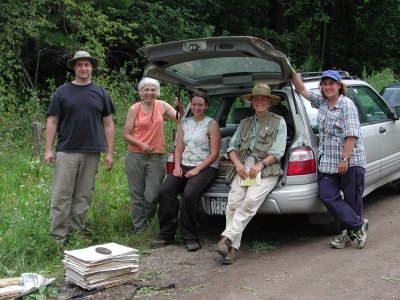
Montgomery County Flora Survey, Doug Idleman, Connie Tedesco, Jamie Barber, Laurie Freeman and Donna Vogler

Montgomery County Flora Survey, Doug Idleman, Connie Tedesco, Jamie Barber, Laurie Freeman and Donna Vogler. Photo: Steve Young

Don’t Forget to Buy NYFA Gear.

Posted September 18, 2009 by nyflora
Categories: NY Flora Association

Our new website www.nyflora.org links to the Cafe Press site where we have many items for sale with our logo.  Shirts, hats, mugs and even buttons.  Take a look and proudly wear your NYFA logo. A percentage of the proceeds from each item helps us continue with our projects to study and protect our native flora.

hat