Here is a good video from the University of Wyoming about how to collect plants for botanical specimens.
Here is a good video from the University of Wyoming about how to collect plants for botanical specimens.
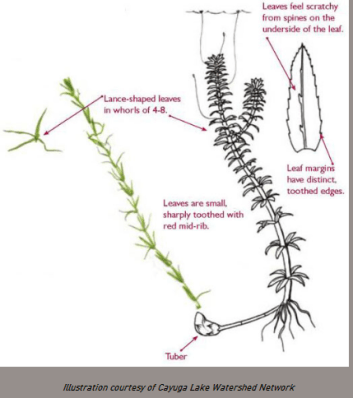
The invasive aquatic plant Hydrilla has been found in the inlet to Cayuga Lake in Ithaca. This may have a big impact on the lake and its native aquatic flora in the future. For a 40 minute video about the infestation CLICK HERE.
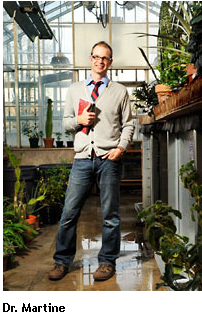
Public radio station WAMC in Albany featured Dr. Chris Martine on their Academic Minute show this morning. Chris talked about the different ways plants reproduce. To hear the feature CLICK HERE.
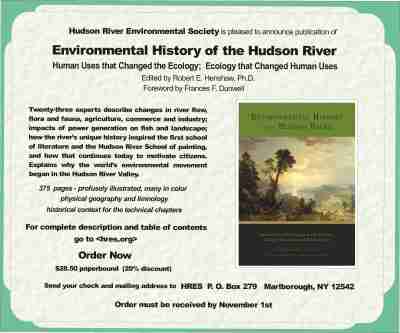
CLICK HERE for more information on this new book about the history of the Hudson River Valley. It includes 3 chapters on native vegetation:
10. Vegetation Dynamics in the Northern Shawangunk Mountains: The Last Three Hundred Years
John E. Thompson and Paul C. Huth
12. Ecology in the Field of Time: Two Centuries of interaction between Agriculture and Native Species in Columbia County, New York
Conrad Vispo and Claudia Knab-Vispo
13. The Introduction and Naturalization of Exotic Ornamental Plants in New York’s Hudson River Valley
Chelsea Teale
CLICK HERE for a simple animation about making an herbarium specimen. It is from the website honoring the legacy of Canadian botanist John Davidson. Click on the activity learning summary at the bottom of the page to learn more about herbarium specimens. – Steve Young
Get the latest information about what invasives are being mapped, where new invasives are turning up, announcements and more. CLICK HERE to see the page and become more involved in helping iMap locate invasive species.
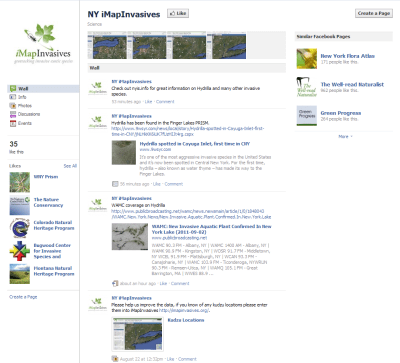
Screenshot of the iMap Facebook page
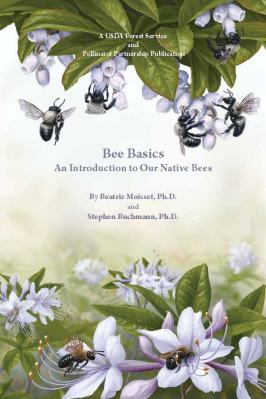
CLICK HERE to see an excellent and beautiful publication on the identification and natural history of our native bees. For those of you focusing on the pollinators as well as the flowers, this publication will help you understand the diversity and behavior of our native bees.
I made a trip to Long Island recently and had the opportunity to see some interesting natural areas. – Steve Young

The beach at Goldsmith's County Park on the Long Island Sound side of the North Fork. Looks like some sand management is going on.

Some of the common beach plants include clotbur . .

and sea rocket, whose fruits actually look like little rockets ready to blast off.

On the dunes, masses of Rosa rugosa were in fruit.
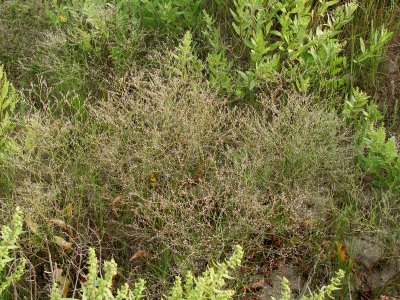
Sea lavender was fairly common and in full flower.
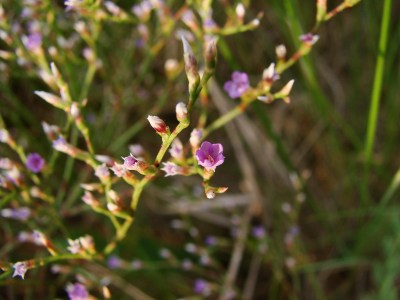
Sea lavender, Limonium carolinianum, is our only representative of the Leadwort Family, Plumbaginaceae, in New York.

Spikegrass, Distichlis spicata, is also a common representative of salt marsh vegetation.

Saltmarsh-elder, Iva frutescens, one of our shrubby composites, was releasing pollen from its ragweed-like flower clusters.

It was sprinked on the opposite, succulent leaves below.
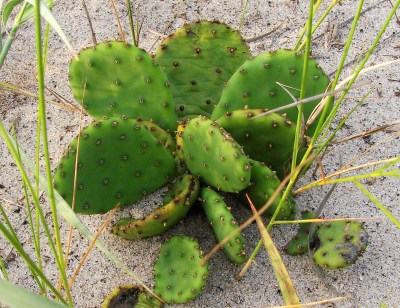
Prickly pear cactus was in among the dune plants but I didn't see any flowers or fruits.
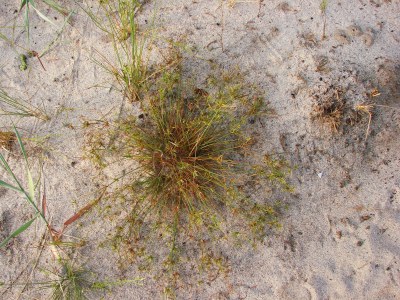
Gray's flatsedge forms a clump of stems in the dunes. It has many rays in the inflorescence and bulbous roots if you dig it up.

In the woods closer to the road was a stand of sweet pepper-bush, Clethra alnifolia, in flower and in fruit.

West of Riverhead, I walked to a rare coastal plain pond to see that the water levels were up to the top. In drought years these ponds drain down to reveal many more plant species that are waiting patiently to germinate when the water is low.

It was raining a lot of the time but on the way back the sun came out to shine across the leaves of the pitch pine oak forest.

Glistening water droplets hung from the ends of the pitch pine needles.
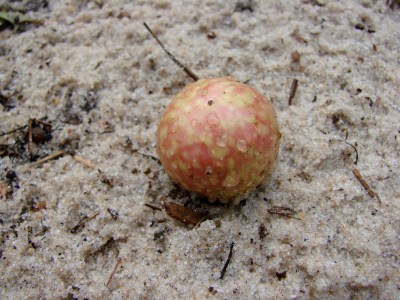
An oak gall had dropped from a tree to the sandy trail.
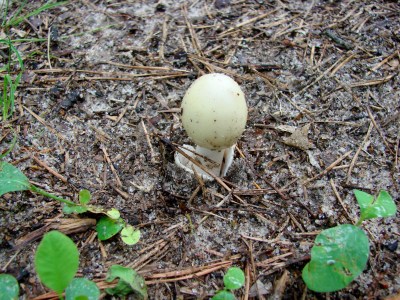
Scores of new mushrooms were arising out the the sand in the trail too.

On the firebreak between forest patches an exotic catalpa has managed to survive, the only one I saw.
Since this visit Hurricane Irene has paid a visit to the Island and these forests probably look a little different now. I’ll have to go back and see how they fared.
The Wall Street Journal published an article yesterday about the lack of taxonomists in the world and how fewer young people are taking their place. As an aging taxonomist and plant explorer myself I have noted this trend for years, as well as the decline of botanical studies in our schools and universities. I have also felt the thrill of discovery many times, in the tropics (see Arthrostylidium youngianum) and in New York, and I hope we can hand that down to more young scientists who will decide to become plant taxonomists. There is still a lot to be discovered out there! – Steve Young
To read the WSJ article CLICK HERE.

Plant taxonomists are hardy souls that will go anywhere to find a new species. Connie Tedesco and Donna Vogler explore a marsh.
I recently came across a website called identifythatplant.com by Angelyn Whitmeyer from North Carolina that contains resources and tips for identifying plants. One of the videos is below:
CLICK HERE to see the full list of videos and the website.
This is a good website for beginners and contains useful information on plant identification. Check it out and let others know what you think in the comments section. – Steve Young


 New York Flora Association Blog