Archive for the ‘Field Techniques’ category

Web Sources for Old Aerial Photographs

May 22, 2010

Wouldn’t it be nice to see what your area looked like from the air as far back as 1938? Vegetation changes are readily apparent when you compare them to aerial photographs of today. For New York I have found two sources that have old aerial photographs available for viewing on the web. The first is from Cornell University and includes counties from central New York. The second is from a website called historicaerials.com which provides old aerial photographs in the Lower Hudson area and Long Island.

The 6 counties of Central New York are available at: http://aerial-ny.library.cornell.edu/

And Long Island aerials are available at: http://www.historicaerials.com/

Have fun!

The north end of Cayuga lake in 1938

Will Cheap Aerial Drones Improve Plant Surveys?

May 7, 2010

From Steve Young – Inventors are coming up with cheaper and cheaper aerial drones that may be used to look at plants in inaccessible areas like deep marshes, cliffs and in the canopy.  I have not seen any of them being used for this purpose yet but it is a matter of time and money.  Click Here to see a video of a drone controlled by an iPhone.  Who will be the first person to make a new botanical discovery using one of these drones?

Parrot Microdrone

Will the iPad Revolutionize Field Studies?

April 25, 2010

The iPad promises to revolutionize botanical field studies by providing a place to store field manuals as well as accessing plant keys and photos over the web. Can you think of how you would use the iPad to help you in the field? Comment below.

What could you do in the field with the iPad?

Rails to Trails And The Need for Botanical Surveys.

January 29, 2010

The link below shows the need for complete botanical surveys when old railroads are converted to trails for the public. The article is by Steve Daniel who has had experience with a trail conversion near Rochester. The article also appeared in a recent issue of the NYFA News – Steve Young

http://www.saveauburntrail.org/home/not-an-ordinary-rail-bed

NYS Museum Conservation Seminar Series – October Plant Lecture

September 19, 2009

The New York State Biodiversity Research Institute and New York State Museum are sponsoring a Biology and Conservation lecture series in October. A variety of speakers will present lectures on recent biodiversity research and conservation initiatives in the state. The lectures are free and will be held at noontime on Wednesdays in the state museum theater.

Wednesday, October 28, Noon
Forgotten Floras: Making the Case for Vouchered Plant Collections
In 2004, a species-area curve analysis revealed that at least 10 counties in the state documented fewer than half the plant species than predicted. Five years later, Otsego, Montgomery and Fulton counties were surveyed, generating more than 1,000 new records, including several rare and some newly invasive plants. Dr. Donna Vogler, of the State University of New York College at Oneonta, discusses the major findings of those efforts and the role of voucher-based natural history collections in the increasingly molecular and digital world of biology.

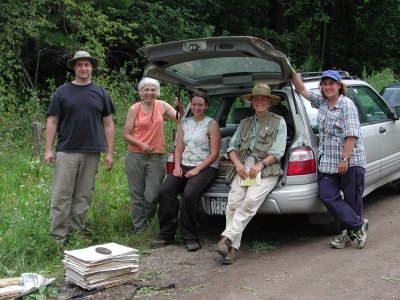
Montgomery County Flora Survey, Doug Idleman, Connie Tedesco, Jamie Barber, Laurie Freeman and Donna Vogler

Montgomery County Flora Survey, Doug Idleman, Connie Tedesco, Jamie Barber, Laurie Freeman and Donna Vogler. Photo: Steve Young

A Good Day At Catskill Marsh

August 16, 2009

From Steve Young: On Thursday the 13th of August I joined Chris Zimmerman of The Nature Conservancy and Melissa Kalvestrand, a graduate student at SUNY Albany, on a trek through the freshwater tidal marsh and mudflats of Catskill, or Ramshorn, marsh.
Catskill Marsh 2009

Melissa gathered up all the equipment needed to record the plants in each plot of the marsh within and around a patch of Phragmites.  The data will be used to analyze the effect the removal of the Phragmites will have on the marsh vegetation. Fortunately I got the middle of the canoe and Chris and Melissa paddled across Catskill Creek to the marsh, a short distance away.

Catskill Marsh 2009-2

Chris carried the plot marker through the high Phragmites with Melissa in the lead.  They had marked the plots with GPS and flags on previous days so it was not trouble finding them again.
Catskill Marsh 2009-5

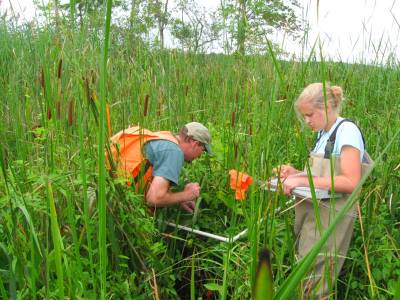
At each plot Chris estimated how much cover each species produced in the square while Melissa recorded the data. I was there to help them with plant identification to make sure all we didn’t miss anything.
Catskill Marsh 2009-6

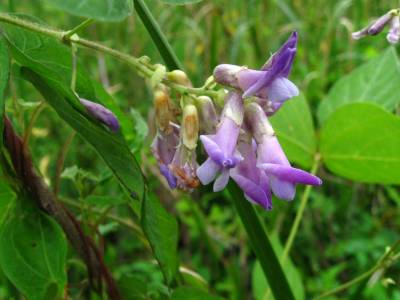
We saw a wide variety of plants in the marsh, some common species like the flowers of hog peanut here (Amphicarpa bracteata), and many other species that can only be found in marsh habitats.

Catskill Marsh 2009-7

There are lots of species with arrow-shaped leaves like this leaf of wapato (Sagittaria latifolia).  There’s also arrowleaf (Peltandra virginica), pickerel-weed (Pontederia cordata) and spatterdock (Nuphar advena).  They are not so hard to tell apart in flower but it’s good to know what they are in leaf and the characters that separate them.

Catskill Marsh 2009-14

For the few hours of low tide a whole new flora reveals itself as the water goes down and the small mud plants appear, mostly strap-leaf arrowhead (Sagittaria subulata) but other small mud plants are hidden among the larger ones and one has to be willing to get down in the mud to see them (take note Mike Rowe of the Discovery Channel). At high tide the spatterdock leaves float on the surface of the water but at low tide the rest of the plant is seen stretching up from the mud. One wonders how much photosynthesis these plants can get in while exposed since their leaves are often covered in mud.

Catskill Marsh 2009-20

We were fortunate enough to see the flowers of the little strap-leaf arrowhead with are male and female.  The male flower is shown here with three white petals and yellow stamens.

We were able to finish the plots by midafternoon under cloudy and cool conditions with no mosquitos! It was a great day in the marsh and we even got so see a few plants of swamp lousewort (Pedicularis lanceolata), a state threatened plant. It was time to go home and hose the mud from the jeans before they went in the washer.


When will plant manuals go digital?

April 20, 2009

I just finished reading an article entitled “How The E-book Will Change The Way We Read And Write” in the April 20 Wall Street Journal. It makes me wonder when our plant manuals will become available electronically and all we have to take into the field is an ebook reader instead of those heavy manuals.  Maybe some manuals are, I just don’t have a Kindle to find out.  I imagine that we will soon be accessing manuals and online identification websites through e-readers, smartphones, or netbooks.  It will be interesting to see if it makes plant identification easier. I tend to like indented keys rather than bracketed or random access keys which many websites feature.  When the hardware becomes light enough and portable enough and the the internet is accessible in most places, we should see an increase the the ease of identifying plants.  Maybe sites like Twitter could provide instant identifications from others monitoring the site.  The future holds many possibilities to make it easier for the amateur and professional as well to identify our native flora. – Steve Young