Archive for the ‘Invasive Species’ category

Phragmites Eliminates Rare Plants

October 14, 2010

From Steve Y0ung, NY Natural Heritage Program.

On October 12th I went to the TNC preserve called Big Woods on the South Fork of Long Island to update 5 rare plants growing in the high salt marsh there.  They were last documented there in 1995 and were thriving in a beautiful and diverse salt marsh. With three other people we searched the shoreline but were met again and again with the scene below.

In the last 15 years Phragmites australis had taken over the entire high marsh and eliminated the Iris prismatica, Salicornia bigelovii, Lilaeopsis chinensis, Sabatia stellaris and Plantago maritima. Many of the high salt marsh areas on Long Island are now changing to Phragmites monocultures and these saltmarsh rare plants will disappear completely in the years to come. We hope to survey more marshes next year to get an idea of how quickly this process is happening and what we will actually lose.

Interested in Pulling Kudzu in Rockland County? Here’s Your Chance.

October 6, 2010
For anyone interested in volunteering for the kudzu pull in late fall in Rockland County, NY we are awaiting landowner permission and should have a date specified soon.
Thank you,
Jessica Rohloff Cancelliere
Assistant Entomologist
Division of Lands and Forests
NYS Dept. of Environmental Conservation
(518) 810-1609
jarohlof@gw.dec.state.ny.us

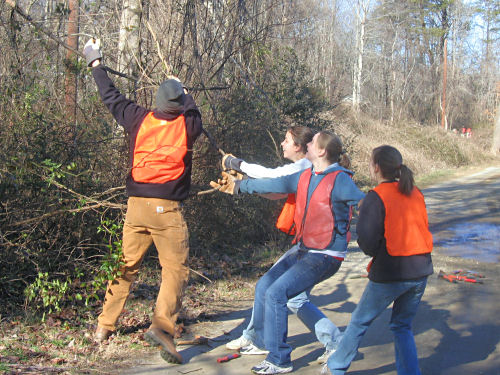
A Kudzu pulling party in South Carolina.

Black Walnut in Danger of Being Destroyed in Eastern Forests

September 22, 2010

Thousand Cankers Disease has been found in Tennessee recently and there are fears that it will spread to all black walnuts in the East and eliminate it from our forests.  Will we have any tree species left with all the organisms that are attacking them?  Learn more about TCD in Wikipedia by clicking HERE.

EMERALD ASH BORER DETECTED IN STEUBEN AND ULSTER COUNTIES

July 23, 2010

From a DEC Press Release:

Additional Investigation Planned After Invasive Beetles Found in Traps

New York State Department of Environmental Conservation Commissioner Pete Grannis and state Agriculture Commissioner Patrick Hooker today announced the discovery of the Emerald Ash Borer (EAB) on private properties in the Town of Bath, Steuben County, and Town of Saugerties, Ulster County. The EAB is a small but destructive beetle that infests and kills North American ash tree species, including green, white, black, and blue ash.

The first detection of EAB in New York was in the town of Randolph, Cattaraugus County, in June 2009 (http://www.dec.ny.gov/animals/56774.html). Since the Randolph find, state and federal officials have implemented an extensive monitoring effort that includes the deployment of approximately 7,500 EAB purple traps in ash trees in high risk locations including major transportation corridors.

The Steuben County discovery occurred on July 12 when a state Department of Environmental Conservation (DEC) staff member inspected one of the state’s EAB purple traps. The traps are sticky and contain a chemical lure that attracts adult EAB. The detection was confirmed this week by Cornell University. The Ulster County discovery occurred on July 15 after USDA’s Animal and Plant Health Inspection Service (APHIS) staff member check of a federally-deployed EAB trap and confirmed by USDA APHIS. Each EAB trap had one confirmed EAB specimen.

Do You Know What a Novel Ecosystem Is?

July 16, 2010

The concept of Novel Ecosystems is gaining traction in the conservation community and will have implications with how preserves and other natural areas are managed (less management of invasive species for example).  In the words of one ecologist, “Novel systems will require significant revision of conservation and restoration norms and practices away from the traditional place-based focus on existing or historical assemblages.” If you are interested in how many conservationists are thinking about the future you should become familiar with this new philosophy. It has many implications about the future of our flora in New York.

For more information go to the Google search page for this topic HERE.

NYS INVASIVE SPECIES COUNCIL RELEASES PLAN TO COMBAT INVASIVE SPECIES IN NYS

July 7, 2010

The following is from a DEC press release:

Report Identifies New Process to Categorize Non-Native Invasive Species

The New York State Invasive Species Council today (July 6) submitted its final report to Governor David A. Paterson and the State Legislature. The report, titled A Regulatory System for Non-Native Species, recommends giving the Council authority to develop regulations for a new process that will prevent the importation and/or release of non-native invasive species in New York’s waterways, forests and farmlands.

The report, prepared by the nine-agency Council and co-led by the Department of Agriculture and Markets and the Department of Environmental Conservation, introduces a new process for assessing each invasive species for its level of threat, its socioeconomic value, and for categorizing them into distinct lists for appropriate action.

State Agriculture Commissioner Patrick Hooker said, “In recent years, we have struggled with the economic and environmental impacts of non-native species such as Plum Pox Virus, Emerald Ash Borer and the Asian Longhorned Beetle, but we have also acknowledged the positive aspects associated with some, such as timothy, Norway maple and
lady bugs.  With the adoption of this report, New York will now have a process by which the merits of various invasive species will be evaluated and their level of harm and/or benefit will be reviewed to ensure unacceptable ecological or health risks are not purposefully introduced as pets, nursery stock, food or other uses.”

State Environmental Conservation Commissioner Pete Grannis said, “New York needs to take action now to curb the many pathways that invasive species use to make their way here. With this new regulatory approach, we can do just that.   The system the Council is proposing strikes the right balance of minimizing the major threats to our ecology and economy while allowing for the careful use of those plants and animals that pose lower risks.”

The new assessment process would allow the state to categorize invasive species such as zebra mussels, Sirex wood wasps and Eurasian milfoil  as “prohibited,” “regulated” or “unregulated.”  As a result of this classification system, regulatory control where necessary, would help restrict movement of potentially harmful plants and animals.

Species in the “prohibited” category would be the most restricted as they pose clear risks to New York’s economic, ecological and public health interests, and, therefore, would be banned from commerce entirely.  “Regulated” species would be restricted, but not prohibited from commerce, and require practical and meaningful regulatory programs.  “Unregulated” species would be identified as those non-native species that do not pose a threat and therefore could be used freely in commerce.

Two “tools” would be used in assessing risks from non-native plants and animals.  One evaluates the inherent, biological
“invasiveness” of each species, i.e., some species are better “weeds” than others.  The other tool looks at socio-economic values to help the Council decide whether the social benefits of a plant or animal outweigh the potential harm. For example, earthworms have often been shown to have positive effects on soil structure and fertility in agricultural and garden ecosystems; however, glacial ice sheets that covered most of New York some 11,000 to 14,000 years ago
left New York worm free.  Thus, today’s worms are actually European invaders and considered a non-native invasive species, but are clearly valuable.

The process of categorizing invasive species and other report recommendations were developed with the assistance of a 17-member steering committee comprised of representatives from state and federal agencies, conservation, academic and industry groups including agriculture, pets, nursery and landscape.  In addition to Department of Environmental Conservation  and Department of Agriculture and Markets, the Council is made up of the Commissioners of Transportation, Parks, Recreation and Historic Preservation, and Education; the Secretary of State; the Chairperson of the New York State Thruway Authority; the Director of the New York State Canal Corporation; and the Chairperson of
the Adirondack Park Agency.

The New York State Invasive Species Council*s final report is available online at

http://www.dec.ny.gov/animals/63402.html.

New York State is engaged in efforts to reduce the impacts of existing invasive species, such as the Asian Longhorned Beetle and most recently, the Emerald Ash Borer.  Department of Agriculture and Markets’ horticultural inspectors have successfully treated 549,856 trees in Brooklyn, Queens and Staten Island as part of efforts to eradicate the Asian Longhorned Beetle and protect our forests and urban trees.  The Emerald Ash Borer was found in Randolph, Cattaraugus County, in June 2009.  The Departments of Environmental Conservation and Agriculture and Markets responded quickly and removed affected trees. Since that time over 387 compliance agreements have been written to prevent the human spread of the Emerald Ash Borer.

Is Japanese Lilac-tree Invasive?

June 11, 2010

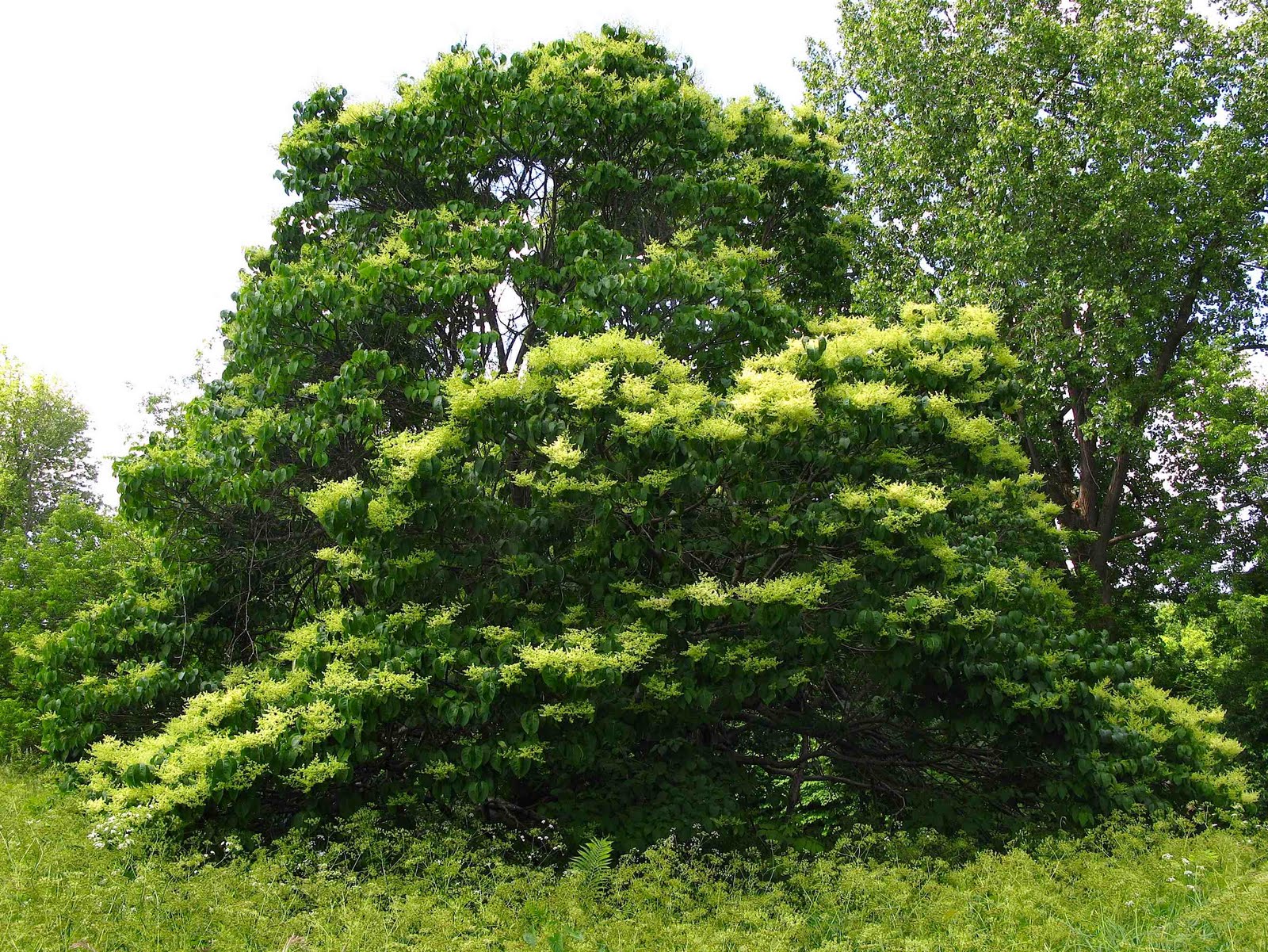
The New York Natural Heritage Program has received two reports this year of Japanese Lilac-tree, Syringa reticulata, naturalizing in floodplains, one in Columbia County and one in Saratoga County. In Columbia County it was reported as a dominant in one area. It has opposite, heart-shaped, drooping leaves and large terminal clusters of small cream-colored flowers. It is in full bloom now and its fragrance is more like an unpleasant privet fragrance than the sweet fragrance of most lilacs. This plant has long been sold as an ornamental but its popularity may be increasing, as well as its opportunity to naturalize.  It has been described on the internet as “not widely naturalizing.”  If you have seen this plant naturalizing in a floodplain or any other natural area please leave a comment below.  We would also like to have an idea of how widely available it is for sale in New York.  Google the scientific name for more information on its natural history and horticultural use.  – Steve Young

Japanese Lilac-tree in Saratoga County. Photo Jackie Donnelly

Have You Seen Giant Hogweed? Call the Giant Hogweed Hotline!

May 26, 2010
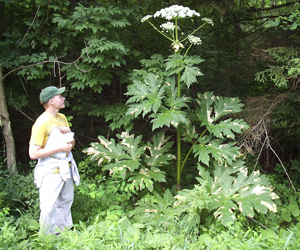
If you have seen giant hogweed in New York call the NYSDEC Giant Hogweed Hotline (845)256-3111. The hotline is a place for people to report new sites, ask questions about the plant and how to control it, and connect with our statewide control project.

Giant hogweed is giant!

Another giant hogweed resource is our NYSDEC giant hogweed web page http://www.dec.ny.gov/animals/39809.html which provides information about the plant, how to identify it, how to control it, a map of NY state sites, and more.
Read the attached document for more information about our hotline, statewide control project, what to tell the public when they call and how you can help.
Thanks in advance for your help,
Naja Kraus
DEC Forest Health & Protection Program Botanist
Giant Hogweed Program Coordinator

CCE Emerald Ash Borer Outreach Training Workshops

March 22, 2010

The Cornell Department of Natural Resources received a grant from USDA-APHIS to conduct a series of workshops in New York State establishing Cornell Cooperative Extension as the source of information and guidance to citizens and communities on the invasive Emerald Ash Borer (EAB).

The EAB is a small beetle from Asia that is spreading throughout the Midwest since the mid 1990’s killing millions of native ash trees in urban and rural settings. It was first detected in western New York State in the summer of 2009 and will gradually spread throughout the state.

The goal of the Emerald Ash Borer Workshops is train CCE Educators and community volunteers as source for trusted information and guidance helping communities prepare for the eventual arrival of this devastating pest.
Fourteen 14 workshops are scheduled throughout the State. The target audience for these workshops is CCE educators, Master Gardeners, Master Forest Owners, Master Naturalists, members of NY’s Partnerships for Regional Invasive Species Management (PRISMs), foresters, tree care professionals, and land management professionals in county and municipal governments.

The workshops will cover topics of vital importance helping individuals and communities prepare for the arrival of the EAB and minimize the potentially devastating economic impacts.

Specific components of the workshop include: introduction and background to the EAB problem; basic EAB biology and identification; EAB control tactics; community stakeholder identification, EAB message development, and effective communication practices; and the design and development of EAB community action plans.

Each 3-hour workshop includes refreshments. DEC pesticide, SAF, ISA, CN/LP and ASLA rectification credits are available or were requested, call for details. We invited are CCE educators, County agency staff, PRISM volunteers and professional land managers. Information about the 249 Highland Avenue, Rochester venue may be addressed to Karen Klingenberger or Walt Nelson @ 461.1000. Registration for the Rochester session may be made at http://www.mycce.org/monroe/

Schedule of Emerald Ash Borer Educational Workshops for CCE

April 14, Wednesday. Allegany & Cattaraugus County CCE.
Contact: Lynn Bliven, lao3@cornell.edu, (585) 268-7644.
3 hr program, 1pm to 4pm at Ellicottville CCE office, 28 Parkside Drive, Ellicottville, NY. Registration: (716) 699-2377 x 125.

April 15, Thursday. Monroe County CCE.

Contact: Karen Klingenberger, ksk8@cornell.edu, (585) 461.1000×225
3 hr program, 1pm to 4pm at Monroe County CCE office, 249 Highland Ave., Rochester, NY. Registration: http://www.mycce.org/monroe/

April 16, Friday. Jefferson County CCE.

Contact: Sue Gwise, sjg42@cornell.edu, (315) 788-8450.
3 hr program, 1pm to 4pm at Jefferson County CCE office, 203 Hamilton St., Watertown, NY. Registration: (315) 788-8450.

April 17, Saturday. Onondaga County CCE.
Contact: Jessi Lyons, jel264@cornell.edu, (315) 424-9485 x 233.
3 hr program, 8:30am to 11:30am, at the Red Mill Inn, 4 Syracuse Street,
Baldwinsville, NY; http://www.theredmillinn.com.
Registration: (315)424-9485 x 0.

April 19, Monday. Greene County CCE.
Contact: Marilyn Wyman, mfw10@cornell.edu, (518)622-9820 x 36.
3 hr program, 1pm to 4pm at the Agroforestry Resource Center, 6055 Route 23, Acra, NY. Registration: (518) 622-9820 x 0.

April 20, Tuesday. Suffolk County CCE.

Contact: Caroline Kiang, ctk3@cornell.edu, (631) 727-7850 x 337.
3 hr program, 10 am to 2pm at the Lecture Hall in the Sports & Exhibition Complex of the western campus of Suffolk County Community College, on Wicks Road just south of the LI Expressway exit 54 in Brentwood, NY. Registration: ctk3@cornell.edu or (631) 727-7850 x 337.

April 21, Wednesday. Westchester County CCE.
Contact: Rick Harper, rwh26@cornell.edu, (914) 285-2622.
3 hr program, 1pm to 4pm at Westchester County Center, 198 Central Ave., White Plains, NY. Registration: Martha Mochbeichel, mpm47@cornell.edu, or 914-285-4620.

April 24, Saturday. Ontario County CCE.
Contact: Jim Ochterski, jao14@cornell.edu , (585) 394-3977 x 402 or Russ Welser, rw43@cornell.edu (585) 394-3977 x436.
3 hr program, 8:30am to 11:30am at Ontario County CCE office, 480 N Main St., Canandaigua, NY. Registration: (585) 394-3977 x427 or nea8@cornell.edu.

April 26, Monday. Steuben County CCE.

Contact: Brett Chedzoy, bjc226@cornell.edu, (607) 535-7161.
2 hr program, 6pm to 8pm at the Civil Defense Center, 7220 Route 54, located on Route 54 between Bath and Hammondsport, NY, across from the Kwik Fill Gas station. Registration: (607) 664-2300.

April 29, Thursday. Chenango County CCE.

Contact: Rebecca Hargrave, jrh45@cornell.edu, (607) 334-5841.
3 hr program, 1pm to 4pm at Sidney Memorial Public Library, 8 River St., Sidney, NY. Registration: (607) 334-5841.

April 30, Friday. Saratoga & Warren County CCE.
Contact: Laurel Gailor, lrg6@cornell.edu, (518) 623-3291.
3 hr program, 1pm to 4pm at Saratoga County CCE office, 50 West High Street, Ballston Spa, NY. Registration: (518) 623-3291.

May 1, Saturday. Saratoga & Warren County CCE.
Contact: Laurel Gailor, lrg6@cornell.edu, (518) 623-3291.
3 hr program, 8:30am to 11:30am at Saratoga County CCE office, 50 West High Street, Ballston Spa, NY. Registration: (518) 623-3291.

May 3, Monday. Essex County CCE.
Contact: Emily Selleck, els52@cornell.edu, (518) 962-4810 x 408.
3 hr program, 8:30am to 11:30am at Essex County CCE office, 3 Sisco St., Westport, NY. Registration: (518) 962-4810 x 403.

May 15, Saturday. Western New York. TENTATIVE.

Contact: Lutie Batt, lcb37@cornell.edu, (585) 786-2251.

How Many Non-Native Species in New York Are Invasive?

January 30, 2010

These are results from the committee to assess the invasiveness of plants in New York State run by Marilyn Jordan of The Nature Conservancy on Long Island and Gerry Moore from the Brooklyn Botanic Garden.

The number of persisting non-native species in New York is 1405.
The number of persisting non-native species assessed as having a High or Very High invasive nature in New York as of January 2010 is 68.

So we can say that a minimum of ~5% of persisting non-native plant species in NYS are invasive.

Any increase in number of species assessed as invasive, or decrease in the number of non-native species thought to be persisting, would increase the calculated % invasive. It is possible (though probably less likely) that the number of non-native species assessed as invasive could decrease in the future, based on new information or interpretations of questions in the assessment form.

Marilyn J. Jordan, Ph.D.
Senior Conservation Scientist
The Nature Conservancy on Long Island