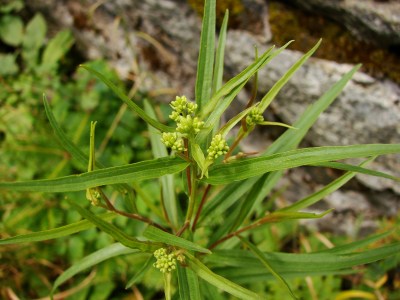
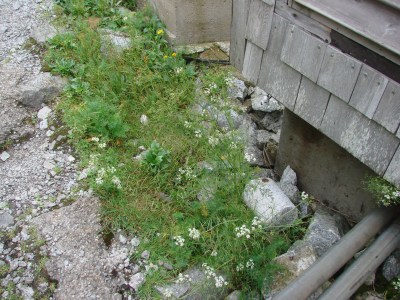
This video presents the history of the Greenbelt and its importance on Staten Island. The Greenbelt is a refuge for many New York State rare plants. It provides an environment for plant enthusiast to observe many species on the extreme southern edge of our flora that aren’t seen elsewhere in the state. This video is included in a series of nature videos available on the website of the Protectors of Pine Oak Woods. CLICK HERE to see the videos. – Steve Young
Staten Island Greenbelt Video. A Refuge for New York Flora.
Posted August 25, 2011 by nyfloraCategories: Natural History, Plant Places
New York Natural Heritage Program Conservation Guides Back Online – With a Few Caveats
Posted August 25, 2011 by nyfloraCategories: Publications, Apps, and Websites
The Natural Heritage Conservation Guides are an important resource for information on rare species and natural communities in New York. Back in the spring the server that housed the information was hacked and damaged beyond repair. It has taken months to reconstruct the database and find a new server that would handle the guides. Through the tireless work of database manager Dave Marston, with assistance from other staff members, the guides are now back online. The basic information is there but there are some things still missing that have to be updated. The first page of a guide has a warning message that needs to be removed, photographs and maps need to be restored, a link to making PDFs doesn’t work yet, and advanced searches still needs to be fixed. This will take a few more weeks but most of the important information is there. These guides receive thousands of hits every month and we’re glad that they are available again. We use them a lot too! – Steve Young
The Michigan Flora is Online. Another Great Resource for NY Plant Enthusiasts
Posted August 24, 2011 by nyfloraCategories: Publications, Apps, and Websites
The new Michigan Flora Online website is available for all vascular plants with keys to families, genera and species. Under each species is a county map, discussion and photos. It includes the new family treatment of the ferns and fern allies so take a look at the changes and compare them to New York. There are also lots of other features which I will let you find for yourself. Happy clicking! – Steve Young
Seven New Plants Added to the List for Whiteface Mountain
Posted August 22, 2011 by nyfloraCategories: Field Trips
On July 30, 2011 the Adirondack Botanical Society had a field trip to Whiteface Mountain in Wilmington, NY. The day started out misty and cold but the clouds later lifted and it was a beautiful day. A walk up to the top along the stairway and back down along the Wilmington trail to the road and parking lot resulted in the discovery of seven new plants not seen before at the top of the mountain. They are listed below, some with photos. To access the complete plant list CLICK HERE. – Steve Young

Hypericum perforatum, Common St. John's-wort, here in bud, was seen along the roadside just below the parking lot.

One plant of Houstonia longifolia, pale bluets, in full flower, was also seen below the parking lot.

Aquilegia canadensis, Columbine, in fruit, was growing near an area of stonework with lots of mortar.

Carum carvi, caraway, a possible invasive species, somehow got established up near the weather observatory.
The other two species, without photos, were Matricaria discoidea, pineapple weed, and Silene vulgaris, bladder campion. They were both found along the roadside near the parking lot. For a complete set of photos from the trip CLICK HERE.
“Plants Are Cool Too!” Video by Our Own Chris Martine
Posted August 19, 2011 by nyfloraCategories: Education and Research
NYFA board member and botanist Chris Martine from SUNY Plattsburg is featured in this video about pitcher plants down south. Click the link.
Assessing the Condition of Wetlands in New York
Posted August 16, 2011 by nyfloraCategories: Field Techniques, Field Trips
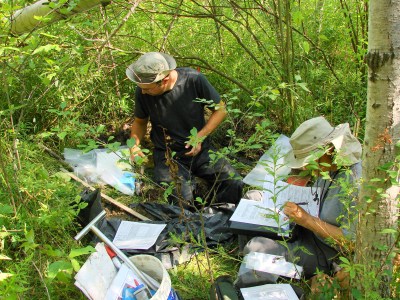
The NY Natural Heritage Program and environmental firm Tetra Tech are teaming up this summer to assess the condition of various wetlands across New York for the EPA. The project began with wetlands in the Adirondacks, continues on to Western New York, and finishes on Long Island. Below are some photos from the work in the Adirondacks. – Steve Young

Each site requires lots of equipment to sample the vegetation in five 100 meter square plots along with soil samples. Some sites are close to roads. Others require some bushwhacking with backpacks.

Chad Barbour and Elizabeth Spencer dig a soil pit near Louisville in St. Lawrence County. Dirty Jobs anyone?

Lots and lots of data and samples are taken at each site. It takes about 6-7 hours to complete the process.

Staff from DEC and TNC helped us access some of the more remote sites. Here Todd Dunham from TNC shows us a small waterfall near one of our sites.

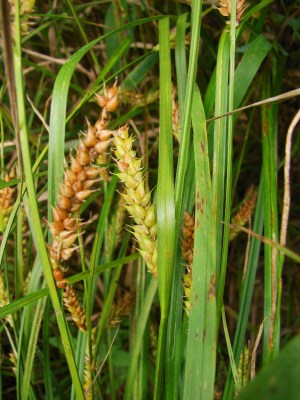
There is always a Carex species or two, or three, or four . . . This is Carex vesicaria in the shrub swamp.

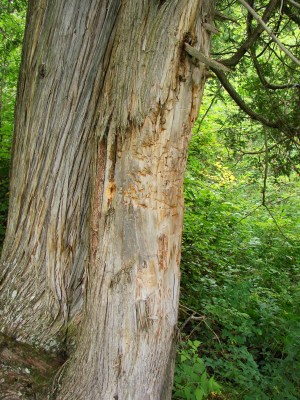
In the spruce-fir swamp we saw the rough bark of red spruce, on the left, with the smoother bark (with resin blisters) of balsam fir on the right.

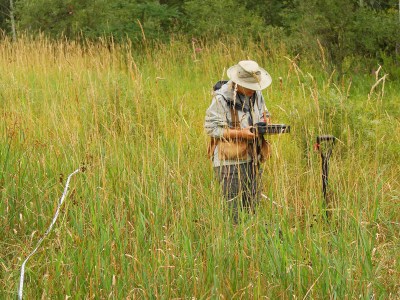
Future posts will document our work as it continues in other regions of the state. Elizabeth records data in the wet meadow.
News About the Status of Butternut From Perdue University
Posted August 8, 2011 by nyfloraCategories: Plant Pathology, Uncategorized
From Keith Woeste, U.S. Forest Service Hardwood Tree Improvement and Regeneration Center (HTIRC)
Dear Friends of butternut;
This letter and THIS CLICKABLE PDF FILE are about butternut (Juglans cinerea). We are providing them to keep you informed about what is happening with butternut and butternut-related research, especially at Hardwood Tree Improvement and Regeneration Center (HTIRC). HTIRC is research collaboration between the USDA Forest Service (Northern Research Station) and Purdue University (http://www.HTIRC.org).
The PDF file contains a description of the mission of HTIRC with respect to butternut, some photos, descriptions of ongoing butternut research, and links to some butternut-related websites.
Many hundreds of foresters, biologists, naturalists and landowners have contacted HTIRC over the past 10 years about butternut. I cannot thank you enough for your pictures and samples and other contributions to our work. I have only ‘met’ most of you by email after you contacted HTIRC. In some cases, your interest and willingness to help were so great that our staff and resources were overwhelmed by the volume of samples and requests. As a consequence, at times I didn’t reply to some inquiries in a timely manner or with all the data you requested. I am sorry for that, and I wish I had more time and resources to offer. Butternut canker is only one of many threats to the sustainability of the eastern hardwood forest, a resource we all value. At a time when funds are scarce, the best way forward is to communicate and cooperate. We do want to hear from you if you have thoughts about research priorities or research opportunities, or if you have resources that may help.
There is no “Butternut Society” or other organized group especially for butternut recovery—at least none that I am aware of. So for now, we will do our best to keep you informed with periodic letters and updates to our website. There is much to do if we are to succeed in keeping butternut a vital part of the eastern hardwood forest. We improve our chances if we all pull together. We expect that updates about butternut will be provided on an occasional basis—certainly no more frequently than twice each year.
Write to me at woeste@purdue.edu if you have any questions or need additional information. My complete contact information is below. Please share this information with anyone who you think will be interested in it.
Yours sincerely,
Keith Woeste
U.S. Forest Service Hardwood Tree Improvement and Regeneration Center (HTIRC)
Department of Forestry and Natural Resources, Pfendler Hall, Purdue University
715 West State Street, West Lafayette IN 47907-2061
web: http://www.agriculture.purdue.edu/fnr/HTIRC/woeste.html
phone: 765-496-6808
Important Changes in Botanical Nomenclature (Naming) Rules
Posted August 8, 2011 by nyfloraCategories: Taxonomy
This post is taken from an article in the Botanical Electronic News by Dr. A. Ceska in Victoria, British Columbia.
IMPORTANT DECISIONS OF THE NOMENCLATURE SECTION OF THE XVIII INTERNATIONAL BOTANICAL CONGRESS, MELBOURNE, 18–22 JULY 2011
From: John McNeill, Rapporteur-général, Nomenclature Section, XVIII IBC, Melbourne 24–29 July 2011
1) Electronic publication
The Nomenclature Section accepted a proposal to add the words in bold to
Art. 29.1 and also accepted a number of corollary proposals, the effect of
the more important of which is described below:
“29.1. Publication is effected, under this “Code”, by distribution of printed matter (through sale, exchange or gift) to the general public or
At least to botanical institutions with libraries accessible to botanists
generally. Publication is also effected by electronic distribution of material in Portable Document Format (PDF; see also Rec. 29A.0) in an online serial publication with an International Standard Serial Number (ISSN) or an International Standard Book Number (ISBN). Publication is not effected by communication of new names at a public meeting, by the placing of names in collections or gardens open to the public, by the issue of microfilm made from manuscripts, typescripts or other unpublished material, or by distribution electronically other than as described above.”
“29.2. For the purpose of this Article, ‘online’ is defined as
accessible electronically via the World Wide Web.”
In order for any nomenclatural action, e.g. the description of a new
species, the transfer of a species to a different genus, or actions
(typifications) to fix the application of a name, to be effective, it must
be “effectively published” Article 29 specifies what this means. Hitherto
the distribution of printed matter has been necessary– now this may also be distribution of electronic material in pdf.
The effective date of the new provisions is 1 January 2012, a year earlier
than would be normal for implementation of a decision to change the Code’s requirements.
There are also provisions establishing that the content of a particular
electronic publication must not be altered after it is first issued and that
a version indicated as preliminary is not effectively published.
For published comment see:
http://www.nature.com/news/2011/110720/full/news.2011.428.html
2) Modification of the Latin requirement
Currently, in order to publish the name of a new taxon, e.g. a species, of
non-fossil plants a description and/or a diagnosis in Latin must be
provided. The Nomenclature Section modified this so that effective from 1
January 2012, the description and/or diagnosis may be in either English or Latin for valid publication of the name of all new taxa. [This is the
current requirement for names of plant fossils, published on of after 1 January 1996 – previously for fossil plants it was any language.]
Since 1935 a Latin description or diagnosis has been required for new taxa of all non-fossil plants, except algae, for which the requirement has
existed since 1958.
3) “One fungus – one name” and “one fossil – one name”
For over 30 years, the “International Code of Botanical Nomenclature” has had provision for separate names for asexual and sexual morphs of those
fungi whose life history involves such very different morphological
expressions that, until recently, were commonly impossible to link one to the other. Molecular studies have changed this situation very substantially, and more and more connections are being made, so that the asexual phase (the anamorph) and the sexual phase (the teleomorph) of the one fungal species are increasingly being identified.
As a result it has become increasingly anomalous to have separate names for the anamorph and the teleomorph phases of the one fungal species, and the concept of one name for one fungus has become increasingly supported by mycologists even with a – One Fungus – One Name symposium held earlier this year in Amsterdam, leading to an Amsterdam Declaration seeking this change in the Code.
The Nomenclature Section agreed to delete the Article (Art. 59) with the
detailed provisions for anamorph and teleomorph names that included a
restriction that the name applied to the whole fungus (the holomorph) had to be one that was based on a teleomorphic element. In the place of the current Art. 59, provisions to minimise nomenclatural change as a result of adopting the one fungus, one name principle. This change will take effect from 1 January 2013.
The nomenclature of fossils falling under the “Code” has had similar but
even more extensive provisions for separate names for fossils that might
prove to belong to the same species. In the current “Code”, a name based on a fossil applied only to the part of the organism, the life-history stage,
or the preservational state represented by the fossil upon which the name was based. Named fossil taxa were therefore different from those of
non-fossil organisms and were termed “morphotaxa”.
This meant that even if organic connections could be made between different fossils, there was no clear provision for naming the more complete organism.
The Nomenclature Section decided to abandon the whole concept of morphotaxa, and as a result names of fossils will be exactly like other names, and if organic connections are made the earliest name applicable to the integrated fossil taxon will be the name to use, so as with fungi, the principle of “one fossil, one name” has been adopted.
4) “Registration” of names of fungi
Most of the major journals publishing mycological papers currently require, as a condition of acceptance of the paper, that any new name being published includes a “MycoBank” identifier. The Nomenclature Section agreed to go a step further and require this for valid publication of any new fungal name.
The main components of the new Article are:
“For organisms treated as fungi under this “Code” (Pre.7), from 1 January 2013 the citation of an identifier issued by a recognized repository … in
the protologue is an additional requirement for valid publication.
Further clauses explain that the minimum elements of information being
registered must be those required for valid publication under the existing provisions of the “Code” (Art. 32.1 (b–e)) and establish that the
Nomenclature Committee for Fungi has the power to appoint “one or more localized or decentralized open and accessible electronic repositories to perform this function” to remove such repositories at its discretion; and even to set aside the requirement should the repository mechanism, cease to function.
The currently appointed repository is “MycoBank” (http://www.mycobank.org)
5) Title of the “Code”
In order to make clearer that the “Code” covers fungi as well as green
plants the Section agreed that the title should be:
“International Code of Nomenclature for algae, fungi, and plants”,
instead of the existing “International Code of Botanical Nomenclature”.
Our Disappearing Flora and Deer
Posted August 1, 2011 by nyfloraCategories: Ecology, Invasive Species
The deleterious effect of too many deer on native vegetation has been known for some decades now and many studies have been done in New York. Unfortunately we are still unable to change policy and practices to reduce the deer herd to levels where our vegetation can recover. Two recent articles have come out demonstrating how far we have to go to tackle this problem and save our flora from the ravages of overabundant deer. One is a report by Tom Rawinski on his visit to see deer exclosures on Shelter Island. The other is a pair of articles about the loss of the flora from deer herbivory in Letchworth State Park by Doug Bassett and Steph Spittal. – Steve Young
CLICK HERE for the Shelter Island story.
CLICK HERE for the Letchworth story.
CLICK HERE for a deer story from East Hampton.
New Botrychium Key for New York
Posted July 19, 2011 by nyfloraCategories: Publications, Apps, and Websites
Art Gilman created a Botrychium Key for the NYFA Botrychium workshop in June. You can access the key by CLICKING HERE. We need more information on this group of ferns for New York so we hope you can get out in the field and use this key.