Adirondack Botanical Society Gets a New Logo

Posted April 8, 2012 by nyflora
Categories: Plant Organizations

The Adirondack Botanical Society is proud to announce their new logo. Many thanks go to Sheri Amsel of Adirondack Illustrator for donating the use of her drawings and to a number of ABS members who provided thoughts and feedback to help develop the logo.

To join the Google discussion group for the Adirondack Botanical Society send an email to adkbotsoc+subscribe@googlegroups.com. Write Join in the subject line. You can state why you would like to join in the body of the email.

Their next meeting and field trip will be April 21st at Coon Mountain near Westport. More field trips are being planned (June 16 to Mount Skylight and July 28 to Whiteface Mountain among others) and a new native plant garden is in the design phase for the Paul Smith’s Visitor Center.

Follow NYFA on Twitter

Posted April 8, 2012 by nyflora
Categories: Publications, Apps, and Websites

You can now follow us on Twitter to get real-time updates on what’s blooming, field trips, workshops, conferences, botanical articles and more! Our twitter address is @newyorkflora. If you tweet about our flora we can also retweet it here. Our blog side panel displays the latest 3 tweets. Enjoy!

Bark: A New Field Guide to Northeastern Trees

Posted April 1, 2012 by nyflora
Categories: Publications, Apps, and Websites

Here is a book that has not been done before but is a great help to identifying trees in the winter or when the leaves and buds are too high off the ground to ID easily. As it says in the Foreword, why hasn’t this done before, especially in an area where the trees are leafless for so long?  Many field guides to trees include photos of the bark but this one has color photos from different ages of the trees to show how bark changes over the life of the tree. There is a nice introduction about the structure and different kinds of bark as well as bark ecology. Make sure you read this section before using the rest of the book. Michael focuses on 67 species of native trees that grow over 30 feet tall. He advises caution when using it in urban parks and streets where many exotics are planted. A series of illustrated keys gets you to the right group of trees which are well illustrated and described. This book will be a great addition to other tree books that we use in the field. No native tree shall go unidentified!

For more info on the book and Michael’s speaking schedule (close to Eastern New York and one in the Catskills in July) click on his website below. – Steve Young

www.knowyourtrees.com


Learn New York’s Trees, Shrubs, and Vines at Landis Arboretum’s New Native Plant Collection

Posted March 23, 2012 by nyflora
Categories: Horticulture, Plant Biology, Plant Distribution, Plant Identification, Plant Organizations, Taxonomy

Landis Arboretum, high on a hilltop above the Village of Esperance in Schoharie County, is the best place to see New York’s native trees, shrubs, and vines thanks to the hard work of Ed Miller, volunteer curator of the native plant collection.  At last count, Ed had planted well over 200 species, omitting noxious, alpine, and rare and endangered plants as well as many from the coastal plain that wouldn’t grow well there. Even so, there are species like tupelo, red bud, cucumber magnolia, and persimmon that seem to be doing well and the warming climate doesn’t hurt either. Some northern species like bog birch and balsam popular are doing well too.  Not all species thrive the first time and some have had to be replanted like the sweet birches and witch hobble.

The garden's Willow Pond Trail leads to Ed's Native Plant Collection. This visit took place in early December 2011.

Following a lead from Kew Gardens in England, they planted each species with its family members.  This makes it possible for serious students to easily compare the details of closely related plants. For instance, all 12 species of native oaks are in one area, all six species of maple in another, and all five birches in still another. Other families are similarly grouped.

This area is where all the members of the sumac family can be found.

Since not all plants of the same family like the same conditions, there are areas that feature plants that like the same habitat, like sun, shade and wetlands. Many of the planting areas have mailboxes that contain a laminated map showing where each species is planted.  The other side of the map tells something about the family or the local habitat.

Ed pulls a map from one of the discovery mailboxes in the open sunny habitat.

One of the most popular sites along the the native plant trail is the Bog Garden. It provides a home for trees and shrubs of northern acid bogs and its log structure can be seen from the Landis barn as you approach from the main entrance.  Its a great chance to see these plants up close from a habitat that is often difficult to access.

From the barn, head east to the wooden bog garden. You may find Ed there to greet you!

Now is a great time to visit the garden to see the early flowers of many of the woodies, especially the overlooked wind-pollinated trees. The native plant trail is an excellent teaching tool and an invaluable resource for learning the woody plants of New York. Come visit soon!

In this area you will find the native dogwoods grouped together.

Another good time to visit will be the spring book and plant sale on May 19th, 10am to 4pm.  See their website calendar for details.

A Short Walk Finds Spring on the Way

Posted March 18, 2012 by nyflora
Categories: Field Trips

A short walk through the Woodlawn Preserve in Schenectady today found a few plants in bloom in this unusually warm spring.  Here is a sample. – Steve Young

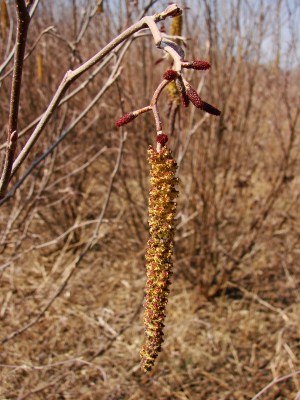
The long male catkins of speckled alder, Alnus incana ssp. rugosa, hang down below the drooping female catkins. Smooth alder, Alnus serrulata, has shorter male catkins and the female ones are more erect.

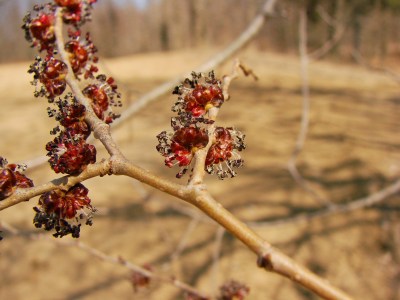
Siberian elm, Ulmus pumila, has flowers in small tight clusters of black and red flowers. Slippery and American elms have flowers on longer pedicels and are not so compact.

These hairy catkins of quaking aspen, Populus tremuloides, with red anthers were waving in the wind.

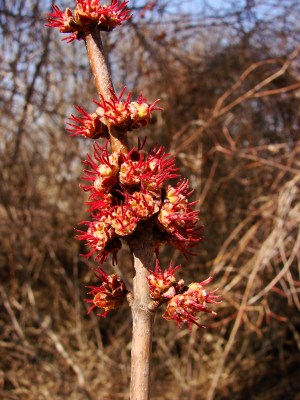
A cluster of female flowers of red maple, Acer rubrum, shows off its very red styles.

Still some months from flowering, young leaves of common mullein, Verbascum thapsus, poke through the dirt.

Newcomb’s Gets a New Cover

Posted March 18, 2012 by nyflora
Categories: Publications, Apps, and Websites

Newcomb’s Wildflower Guide received a new look that changed the old yellow-border wildflower cover to a new one featuring a wildflower meadow leading to a shack and a blue title area. The inside has not changed with taxonomy that is very out-of-date. See our sidebar with a link to the updated names.

20120318-175946.jpg

Ethnobotany Talk by Dr. Michael Balick, NYBG

Posted March 12, 2012 by nyflora
Categories: Classes and Workshops

If you have 90 minutes, take the time to watch this fascinating talk on botanical medicine and indigenous cultures that was presented on Long Island May 6, 2010 by Dr. Michael Balick of the Institute of Economic Botany at the New York Botanical Garden.

Smithsonian April Symposium – Transforming Biology Using Evolutionary Trees

Posted March 8, 2012 by nyflora
Categories: Classes and Workshops

From Dr. Warren Wagner – We are pleased to announce the line-up of speakers for the 2012 Smithsonian Botanical Symposium “Transforming 21st Century Comparative Biology using Evolutionary Trees,” which will be held at the National Museum of Natural History in Washington, DC, on April 20-21, 2012.

Over the last 20 years great progress has been made toward assembling a phylogeny of life on Earth and our expanding knowledge of evolutionary relationships is transforming 21st century biology. The Symposium will address the question: How do we put the knowledge of evolutionary relationships to work to better describe and understand the diversification of life on Earth? The invited speakers will cover a wide range of organisms and topics to illuminate how molecular phylogenetics can be used to understand evolutionary and ecological processes.

–    Scott V. Edwards, Harvard University, “Resolving the Tree of Life through phylogenomics and the multispecies coalescent model”
–    Charles F. Delwiche, University of Maryland, “Illuminating the origin of land plants with algal genomes”
–    James W. Horn, Department of Botany, Smithsonian Institution, “Diversification and structural innovation in Euphorbia”
–    Karen Osborn, Department of Invertebrate Zoology, Smithsonian Institution, “Discoveries in the deep and their usefulness for studies of invertebrate evolution”
–    David D. Ackerly, University of California, Berkeley, “Traits, communities, and history: what do we learn from phylogenies?”
–    Richard Ree, The Field Museum, “Phylogeny and the evolution of floral diversity in Pedicularis (Orobanchaceae)”
–    Michael Donoghue, Yale University, “Adventures in plant phylogeny and prospects for the future”

Abstracts, additional details, and online registration are available on the Symposium Web site: http://botany.si.edu/sbs/. The deadline for registration is 13 April 2012.

Citizen Science Projects With Plants at Project Noah

Posted March 5, 2012 by nyflora
Categories: Publications, Apps, and Websites

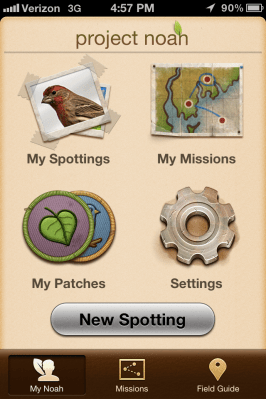
The website and smartphone apps of Project Noah make up a citizen science project that has users create “missions” where people can contribute  information and photos on plants and animals across the globe as well as communicate with other people on the mission. Searching for missions in “New York” you get the following list of missions that include plants:

Wildflowers of New York State – sponsored by NYFA!

Flowers of North America

Great Pollinator Project of NYC

Wildflowers of North America

Ferns of Northeastern U.S.

Plants of Pennsylvania

Flora and Fauna of Prospect Park Brooklyn

Leaves of North America

Grasses of the Northeast

Nature of New York

Fall into Phenology

Weeds of NYC

NYC Parks Life

Northeastern Freshwater Wetland Wildlife and Vegetation

More information about the purpose of the project is HERE.

It has teacher resources so you can use it for a nature study curriculum and it has also been used for bioblitzes. The nice part is that you can use your smartphone to enter data quick and easy but of course since it can be used by everyone, the quality of the reports are not always the best.

Explore the site and see what you think. If you like the idea, join the Wildflowers of New York State and start entering data! – Steve Young

This is the title page of the iPhone app.

Botanists Becoming Endangered Species

Posted March 2, 2012 by nyflora
Categories: Education and Research, People, Plant Biology

An alarming trend has been identified in natural areas management—and it has nothing to do with climate change! However, it does involve the potential loss of a ‘keystone species’ in the natural areas field: the botanist.”  Natural Areas News 2012

A recent study and report by the Natural Areas Association identifies the plight of botany in the U.S. – some which we know all too well. A New York botanist recently said, “Frankly, it’s probably already too late, as we’ve lost the key generation that should have carried real botanical knowledge across the gap to the present.” Let’s hope not.

There is also a list of recommendations. For the report CLICK HERE.

Botanist John Wiley surveys for endangered plants along Seneca Lake. Are botanists endangered too?